
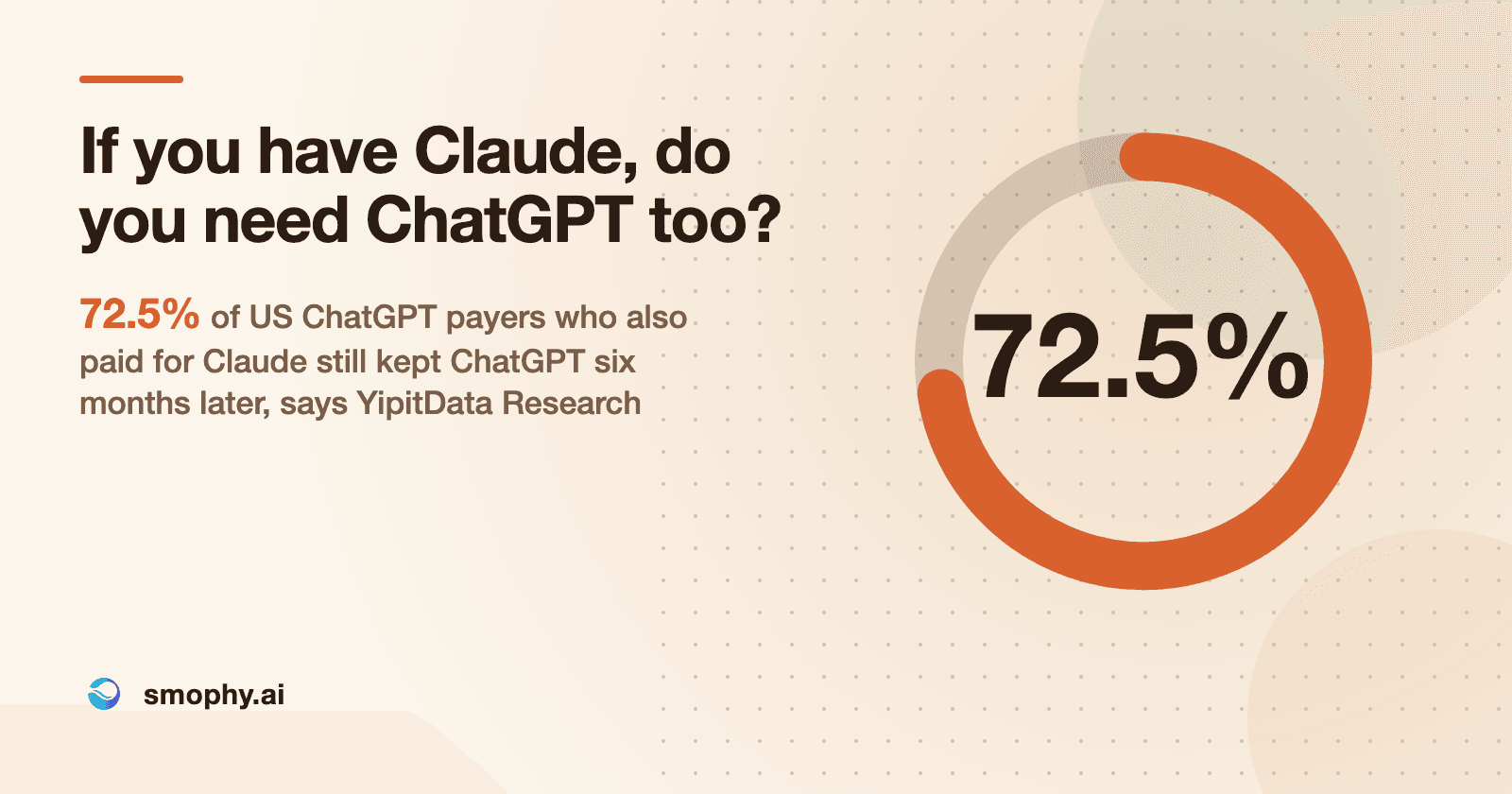
Nearly one in three people who pay for both keep only one plan within six months. YipitData Research found that US ChatGPT payers who also paid for Claude kept ChatGPT at 72.5% after six months, against 80.4% for people who paid for ChatGPT alone. If you want answers from both models without paying twice, the cheaper route is one workspace where ChatGPT and Claude answer the same prompt side by side.
How many people pay for both ChatGPT and Claude?
Paying for more than one assistant is common enough to show up clearly in purchase data.
YipitData Research followed 2,439 people in its US e-receipt panel who paid for both ChatGPT and Claude. YipitData Research found that after six months, 24.7% of them kept only Claude, while 5.0% kept only ChatGPT.
The overlap is not limited to those two. YipitData found that 37.8% of US panelists with an active Google One AI Pro or Ultra plan also paid for Claude, ChatGPT or Perplexity in the first half of the year, with a Claude overlap of 24.5% and a ChatGPT overlap of 19.3%.
What happens when people pay for both?
The retention numbers show how often a second subscription gets cut.
YipitData Research measured ChatGPT retention at 72.5% after six months for people who also paid for Claude, compared with 80.4% for people who paid for ChatGPT alone. In the same YipitData Research data, 24.7% of dual subscribers kept only Claude and 5.0% kept only ChatGPT, so nearly 30% narrowed down to one plan within six months.
For anyone paying two monthly charges for two chat assistants, that is the pattern to watch: one of the two plans often ends up as the one you cancel.
Is one model better at everything?
No single model leads on every measure, which is why people keep reaching for a second one.
Artificial Analysis built AA-Omniscience, a benchmark of 6,000 hard knowledge questions, to measure both accuracy and hallucination, meaning how often a model states something false instead of admitting it does not know. On AA-Omniscience, Artificial Analysis measured the lowest hallucination rate for Claude 4.5 Haiku, at 28%, while the models with the highest accuracy did not lead the overall index, because they guessed more often instead of saying they did not know.
Our own tests show the same split on business questions. In SmophyAI Pain Test PT-05, we gave six models the same problem: a marketing agency loses about three retainer clients a year between month five and month eight although every agreed deliverable was met. All six read it as an outcome gap and proposed a value review with the client, but they timed it differently: GPT-6.1 Sol at day ninety, Claude Opus 5.5 and Sonar Reasoning Pro in month four, and Gemini 4 Argon at day one hundred twenty. DeepSeek V4 Pro added an early warning score built from engagement, meeting attendance and the tone of feedback.
One model would have given you one of those plans. Reading them next to each other gave a choice.
How do you decide whether you need both?
Decide from your own work, not from a leaderboard.
- **List your three most frequent tasks.** For example, client emails, a weekly report and planning a campaign.
- **Write one real prompt for each task.** Use the exact wording you would send at work.
- **Run each prompt in ChatGPT and Claude.** Use fresh conversations and the same wording for both.
- **Mark which answer you would actually send.** Note where they agree and where one adds something the other missed.
- **Count the tasks where the second model changed your decision.** If the answer is zero, one plan is enough. If it is one or more, you need access to both, but not necessarily two subscriptions.
Repeat the check after a few weeks with the same three prompts. New model versions arrive often, and the task where the second model helped last month may look different today.
Can you use ChatGPT and Claude together without two subscriptions?
Yes, by sending one prompt to several models in the same workspace.
SmophyAI is an AI workspace where ChatGPT, Claude, Gemini, Grok, Perplexity and DeepSeek answer the same prompt side by side in one subscription. Multi-Chat sends one prompt to all six at once, and Best Answer combines the strongest information from the responses into one reply.
The plan costs $19.98 a month and includes image, video and writing studios. New models arrive on the same plan, so GPT-6.1 Sol and Gemini 4 Argon joined with no change to the subscription. You can start free and run your three most frequent prompts before you cancel anything.
Common questions
If I have Claude, do I need ChatGPT?
Only if ChatGPT changes your decisions on tasks you do often. Run your three most frequent prompts in both and count how often the second answer makes a difference. If it does, a workspace with both models on one plan is cheaper than two subscriptions.
Can I combine Claude and ChatGPT?
Yes. In SmophyAI Multi-Chat, one prompt goes to ChatGPT, Claude, Gemini, Grok, Perplexity and DeepSeek at the same time, and you read the answers side by side on one screen.
Which subscription is better, ChatGPT or Claude?
Neither wins everything. Artificial Analysis found that the most accurate models on its AA-Omniscience benchmark were not the ones with the lowest hallucination rate, so the better choice depends on the task in front of you.
How much does it cost to use ChatGPT and Claude together?
Two separate chat subscriptions mean two monthly charges. SmophyAI puts ChatGPT, Claude, Gemini, Grok, Perplexity and DeepSeek in one plan for $19.98 a month, with image, video and writing studios included.
Do people keep paying for both ChatGPT and Claude?
Nearly one in three narrow down to one plan. YipitData Research found that ChatGPT payers who also paid for Claude kept ChatGPT at 72.5% after six months, against 80.4% for ChatGPT-only payers.
Sources
About SmophyAI
SmophyAI is an AI workspace where ChatGPT, Claude, Gemini, Grok, Perplexity and DeepSeek answer the same prompt side by side in one subscription, with Best Answer, Smophy Mode routing and studios for images, video and writing. Try Multi-Chat
About the author. Kamil Kępiński is the founder of Smophy Labs Inc. and builder of SmophyAI.
Try SmophyAI today
One workspace for chat, images, video, writing, and business tools.
Start free with 10 messages, then upgrade from $19.98/month when you need more.
Start free at smophy.ai