What can an AI agent do for you every day?
AI agents do tasks for you, not only answer. Everyday examples, and why people trust them only with sources, approval and limits, per new surveys.
Read article →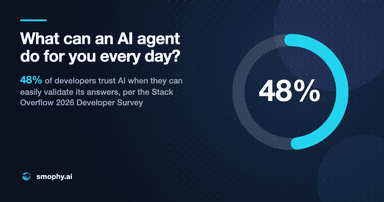

Perspectives on AI, automation, and the future of work. Explore practical ideas for building faster workflows, comparing emerging models, and growing with intelligent tools.
AI agents do tasks for you, not only answer. Everyday examples, and why people trust them only with sources, approval and limits, per new surveys.
Read article →Epoch AI found most workers use AI at work on free plans, while near-daily AI use more than doubled to 19%. When free is enough and when to pay.
Read article →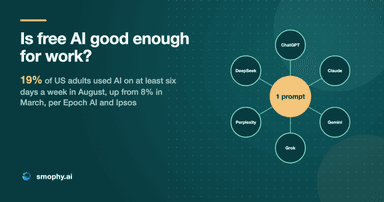
StatCounter measured ChatGPT at 80.48% of AI chatbot market share in September 2026. Why the most popular model is not always the best answer for you.
Read article →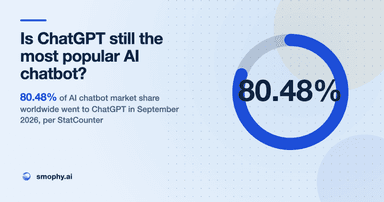
In our SmophyAI Difference Tests, six models split 4 to 2 on one business question and wrote from 16 to 723 words when asked for one sentence. Here is why.
Read article →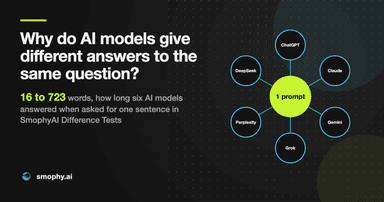
Andreessen Horowitz found only 13% of AI payers pay for a second AI tool. How to choose the one subscription that covers the models you need.
Read article →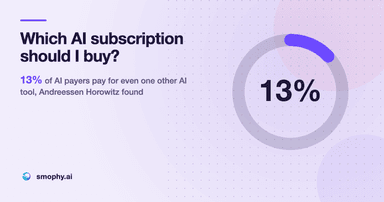
Menlo Ventures found 55% of AI users pay for at least one AI product, and the top 14% of payers make up 60% of spending. What it means for your plans.
Read article →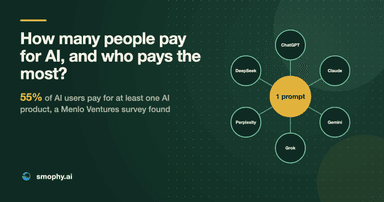
YipitData found ChatGPT kept fewer payers who also paid for Claude. What the data says about paying for both, and how to compare them in one place.
Read article →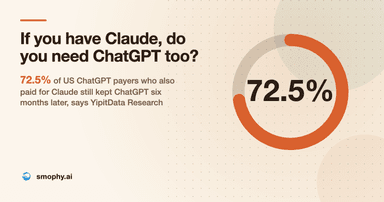
Amplify Partners found 87% of AI engineering teams use several models together. How they route tasks, compare answers and keep costs down, step by step.
Read article →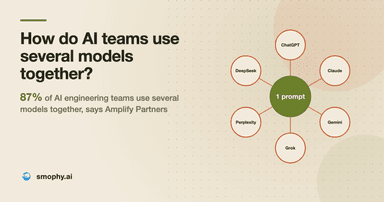
Menlo Ventures counts 3.0 AI assistants per user, yet only 9% of consumers pay for more than one. What the numbers mean for your setup.
Read article →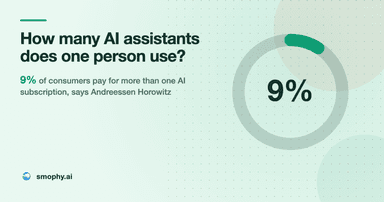
One prompt, six leading AI models side by side, one combined answer. Survey data and our own test results.
Read article →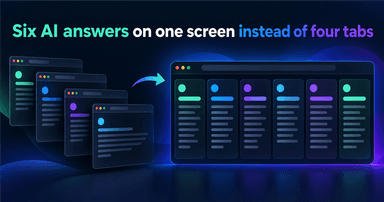
Claude Opus 5.5, Sonnet 5.5, and GPT-6 Astra compared for coding with independent benchmarks, API prices, and recommendations by development task.
Read article →
Compare October 2026 AI model prices, quality, and cost per solved task. Find the best frontier value and cheapest models for your workload.
Read article →
GPT-6 Astra and Claude Fable 5.1 have identical list prices - and real costs that differ up to 2x. Cache rates, the 272K surcharge, and cost per task, explained.
Read article →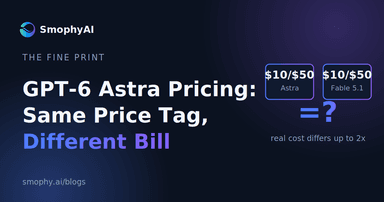
GPT-6 Astra wins math and computer use, Claude Fable 5.1 wins deep reasoning, and both cost $10/$50 per million tokens - with very different fine print.
Read article →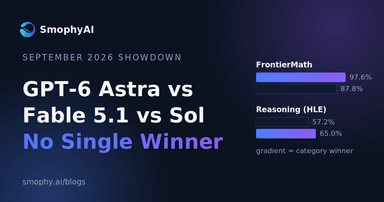
ChatGPT Plus costs $240 a year for one company's models with usage caps. Here is who should pay, who is overpaying, and how the alternatives compare.
Read article →
Three major AI releases landed in five weeks. Here is why manual model tracking no longer works and what an automatically updating AI subscription should actually do.
Read article →
Fable 5 leads the hardest coding benchmark, Sonnet 5 is the value default, and GPT-5.6 Sol leads terminal-agent work. Here is the comparison with the caveats.
Read article →
GPT-5.6 Sol leads on agentic coding, while Claude leads on real-world software engineering and professional analysis. Here is the honest comparison, including the benchmark caveats.
Read article →
GPT-5.6 is three tiers, not one model. Here is what Sol, Terra, and Luna each do, what they cost, and what the independent benchmark story really shows.
Read article →
Research, writing, thumbnails, video, and translation in one creator workspace. SmophyAI brings six AI models and every content format together from $19.98/month.
Read article →
Google does not penalize AI content for being AI. It penalizes thin, unedited content. The workflow that turns AI drafts into content that actually ranks.
Read article →
AI writing is ethical when it assists your thinking and a problem when it replaces authorship that is being assessed. The one question that resolves most cases.
Read article →
The difference is no longer accuracy, it is tone. Why LLM translation preserves register and intent, when to use each, and the workflow for publishable results.
Read article →
Six AI models, image generation, video generation, and a full Writing Studio in one subscription. SmophyAI is the content creation tool built to finish the job.
Read article →
Editing your own writing is the lowest-risk, highest-return AI habit. The four levels of editing, which AI is good at, and how to keep your voice intact.
Read article →
AI detectors are good enough to catch you and unreliable enough to accuse the innocent. The 2026 data on accuracy, false positives, and what it means for writers.
Read article →
When to regenerate, when to edit, when to upscale. The decision tree that cuts AI video cost in half, and the text problem no upscaler can solve.
Read article →
AI writing gives itself away in a few specific ways. How to break each pattern, why specificity is the real fix, and where a rewrite tool actually helps.
Read article →
AI business writing fails by burying the recommendation, not by writing badly. The structural discipline that turns an impressive document into an actionable one.
Read article →
Aspect ratio, length, hook frames and native audio for vertical AI video. The workflow that puts iteration where it actually changes performance.
Read article →
AI book projects fail from voice and continuity drift, not bad prose. The chapter-by-chapter workflow that keeps a manuscript coherent to the last page.
Read article →
The biggest AI essay risk is fabricated citations, not a low grade. The safer workflow uses AI for research and editing, then keeps the prose yours.
Read article →
No single tool wins. Essays, books, reports, and blog posts each have a different failure mode and a different best answer.
Read article →
The six-slot prompt structure that separates cinematic output from stock-looking output, plus model-specific behaviour and the four most common failures.
Read article →
Failed generations cost credits. A usable clip takes 3 to 5 attempts. The full arithmetic of AI video pricing, and three ways to cut spend.
Read article →
Image-to-video needs fewer regenerations and costs less per usable clip. When to use each workflow, plus the reference-driven third option most people miss.
Read article →
Arcads, Creatify, HeyGen and AdStellar compared against multi-model workspaces. Real pricing, model lock-in risk and which one fits your output mix.
Read article →
A six-step workflow for generating multi-scene video ads from product images, with real limits, cost comparison and the settings that actually matter.
Read article →
Veo 3.1 generates native 48kHz synced dialogue in one pass. Full review of strengths, limits, pricing and when to use it over Kling or Seedance.
Read article →
Seedance 2.0 generates video from your own images, clips and audio. Full review of character consistency, subject swaps, real per-second cost and limits.
Read article →
Kling 3.0 Pro costs roughly double per generation. Here is when it is worth it, what Kling's credit system really costs, and how to cut iteration spend.
Read article →
OpenAI closed Sora in April 2026 and plans to shut the API in September 2026. Here is the migration map to Veo 3.1, Kling 3.0 and Seedance 2.0.
Read article →
Veo 3.1, Kling 3.0 and Seedance 2.0 each win a different job. This 2026 comparison covers realism, motion, audio and reference control.
Read article →
Canva, Midjourney, and multiple AI subscriptions create real workflow friction. Here's how SmophyAI's Studio consolidates the generate-edit-format pipeline into one place.
Read article →
Agencies that use AI well do not replace design judgment with automation. They use AI to multiply output while keeping brand consistency under control. Here's how that workflow works at scale.
Read article →
Midjourney, Adobe Firefly, GPT Image 2, and the rest of the modern image stack add up faster than most creators expect. Here's what the fragmented subscription model actually costs in 2026.
Read article →
Infographics, thumbnails, and ad creatives each demand different AI strengths. Here's the tested 2026 workflow for producing all three at production quality - fast.
Read article →
AI image generation is already production-ready for most marketing use cases. Here's the 2026 workflow for turning a creative brief into consistent, brand-appropriate assets at scale.
Read article →
Seedream 5.0 is one of the most underrated AI image models in 2026. It leads on multilingual rendering, reference consistency, and native 4K in ways creative teams should not overlook.
Read article →
Grok Images 1.5 is not the text or photorealism leader, but it has a real advantage in culturally current, trend-aware image generation. Here's when that matters - and when GPT Image 2 is the better choice.
Read article →
Not all AI models handle live web access the same way. Here's the honest 2026 comparison across GPT-5.5, Claude, Grok, Perplexity, Gemini, and DeepSeek.
Read article →
The best AI image for your specific brief is not always the top-ranked model. Here's why side-by-side comparison consistently beats single-model workflows in 2026.
Read article →
Managing too many AI subscriptions costs money and attention. Here's how smart users in 2026 consolidated without losing access to the models that matter.
Read article →
Sakana Fugu and SmophyAI both route prompts to the best AI automatically - but they are built for completely different users. Here is the honest 2026 comparison.
Read article →
Manually picking between AI models for every task is inefficient. Here is how automatic AI model routing works in 2026 - and why it produces better results.
Read article →
Most AI image prompts fail because they describe the subject, not the image. Here's the framework that produces better results - and how AI Enhance automates the hard part.
Read article →
You no longer need design skills or prompt engineering expertise to create polished social media visuals. Here's the practical 2026 workflow from brief to publish-ready asset.
Read article →
There's no single best AI in 2026. Here's a practical framework for routing tasks to the right model so you stop guessing and start getting better outputs.
Read article →
GPT Image 2 leads on text, layout reasoning, and speed, while Nano Banana Pro wins on photorealism, 4K reliability, and editing economics. Here's the honest 2026 comparison by creative use case.
Read article →
GPT Image 2, Nano Banana Pro, Grok Images 1.5, and Seedream 5.0 each win different image tasks in 2026. Here's the tested breakdown - and why running all four at once is the smarter workflow.
Read article →
Gemini 3.1 Pro is stronger than its reputation suggests. Here's when Google's model beats Claude and GPT-5.5, and when it doesn't.
Read article →
Perplexity, ChatGPT, and Claude solve different problems. Here's the honest breakdown of when each one wins and why power users end up using all three.
Read article →
Consultants using AI well in 2026 save real hours, not just minutes. Here's the specific toolkit and workflows that make the difference.
Read article →
The best AI output is often not from one model. It's from comparing several. Here's how multi-model comparison improves accuracy, framing, and decisions.
Read article →
Prompt engineering didn't disappear in 2026. The old tricks died, but the disciplined parts matter more than ever. Here's what still works.
Read article →
Founders getting real value from AI in 2026 use specific workflows, not one tool. Here's how the best-performing ones structure research, writing, and decisions.
Read article →
Perplexity, Claude, Gemini, and GPT-5.5 all win different research tasks. Here's the honest breakdown of which model to trust for what in 2026.
Read article →
Claude leads on code quality, GPT-5.5 wins on tooling, and Grok brings a multi-agent angle. Here's the honest coding comparison for 2026.
Read article →
We tested GPT-5.5, Claude Opus 4.8, Gemini, and Grok across five real writing tasks. Here's where each model actually wins.
Read article →
ChatGPT Plus, Claude Pro, Perplexity, and Grok add up faster than most people realize. Here's what the real AI stack costs in 2026 and where the value shifts.
Read article →
DeepSeek V4 is genuinely impressive on price and performance, but the privacy trade-offs are real for business use. Here's the honest 2026 picture.
Read article →
SmophyAI now uses Brave Search API as the primary real-time data layer across ChatGPT, Claude, Gemini, Grok, Perplexity, and DeepSeek, with fallback providers for reliability.
Read article →
Grok 4, GPT-5.5, and Claude Opus 4.8 each win different tasks in 2026. Here's the honest breakdown of where each model actually matters.
Read article →
Claude Opus 4.8 or GPT-5.5? Here's the honest 2026 comparison across writing, coding, research, and long conversations.
Read article →
Tired of ChatGPT's message caps, uneven output quality, or one-size-fits-most workflow? Here's what power users actually switched to in 2026, and why the winning move is usually a stack, not a single replacement.
Read article →
Comparing TypingMind, Poe, and SmophyAI in 2026? This updated breakdown explains the real workflow split between model access, API-level control, and real-time side-by-side comparison.
Read article →
Looking for a Poe alternative in 2026? This updated comparison breaks down the real workflow difference between model access and side-by-side multi-model comparison across chat and beyond.
Read article →
As we navigate through 2026, AI productivity boosters are reshaping how teams and individuals approach daily tasks, driving unprecedented efficiency and innovation. With the global AI market surging and productivity gains from AI tools becoming more tangible, businesses are increasingly adopting these technologies to stay competitive.
Read article →
A practical guide to the biggest agentic AI trends of 2026, how autonomous systems are changing enterprise workflows, and why SmophyAI helps teams build faster multi-model automations.
Read article →
2025 was the year AI models peaked. 2026 is the year workflows changed. Learn why AI aggregators especially Smophy AI became the new standard by allowing multiple AI models to work in parallel, instantly side-by-side.
Read article →
2025 proved that no single AI model is the best. Instead, the smartest workflow comes from using multiple models at once. This guide compares ChatGPT, Claude, Gemini, Perplexity, Grok, and DeepSeek and explains how Smophy AI gives the fastest parallel workflow of 2026.
Read article →