
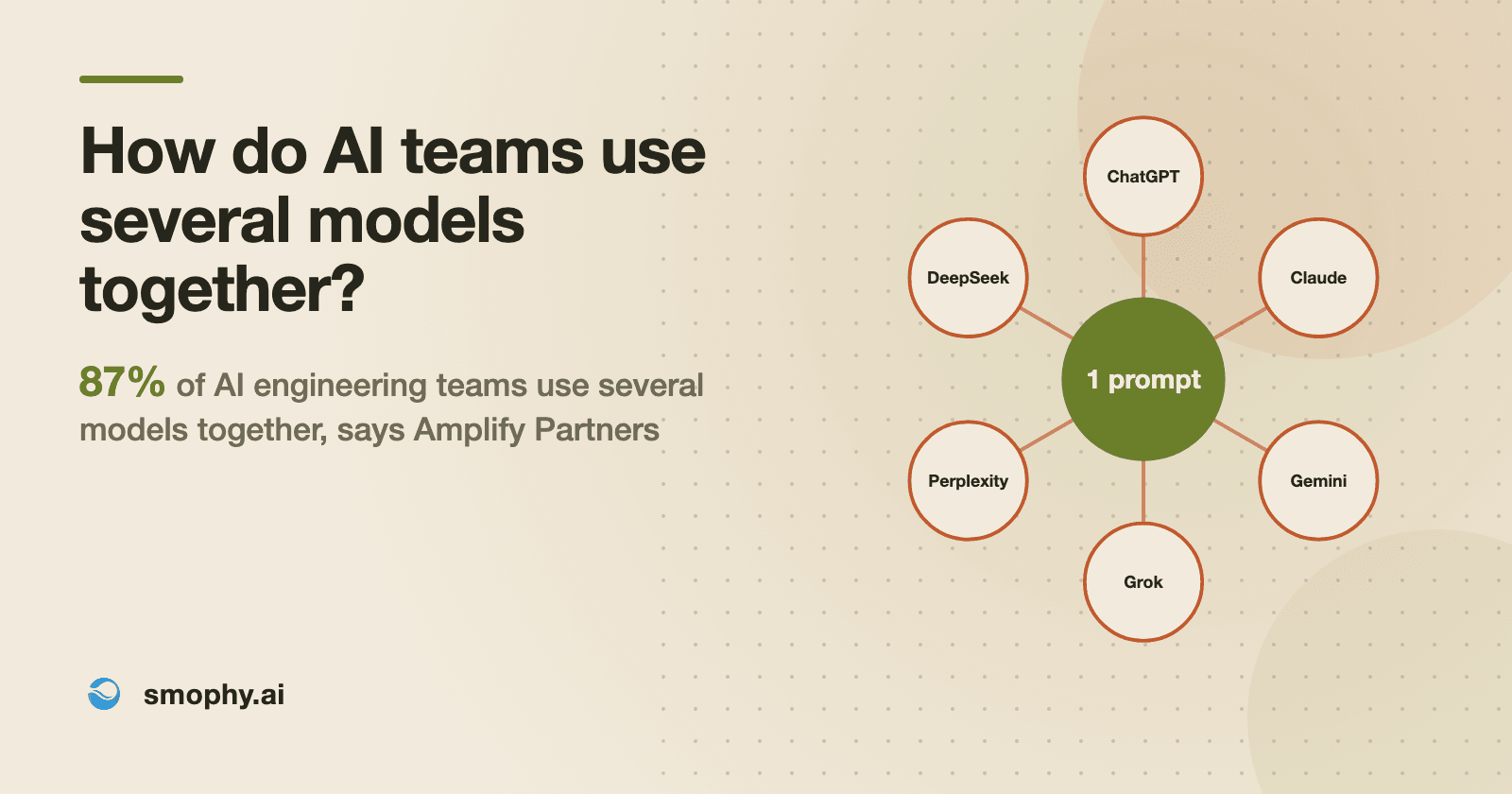
Most AI engineers no longer rely on one model. Amplify Partners found that 87% of AI engineering respondents actively use multiple models together. In the same Amplify Partners survey, the most common method is routing each task by its type, used by 44% of respondents, while 26% run several models and compare their outputs.
How many teams use more than one AI model?
Amplify Partners reports that 87% of AI engineering respondents actively use multiple models together. Among the engineers in that survey, working with several models is the normal setup.
Our own tests show why. In SmophyAI Pain Test PT-05, six models side by side all saw the same problem behind an agency losing clients, yet each timed the fix differently: GPT-6.1 Sol proposed a value review at day ninety, Claude Opus 5.5 and Sonar Reasoning Pro in month four, and Gemini 4 Argon at day one hundred twenty. One prompt, six useful but different plans.
How do teams decide which model gets which task?
Routing by task type comes first. Amplify Partners found that 44% of respondents route by task type, 26% run multiple models and compare outputs, and 11% route by cost.
Routing by task type means deciding in advance which model handles which kind of job. The routing table can be short: one line per task, with the model that handles it and the reason it was chosen. It matters because answers to the same prompt differ from model to model, as PT-05 shows.
Cost is part of the decision too. Amplify Partners reports that three quarters of respondents adjust their AI usage based on cost, and 11% route tasks by cost.
Why do teams compare answers from several models?
Single answers can be wrong. In EBU/BBC research, 45% of AI answers about news had at least one significant issue. The same EBU/BBC study found major accuracy issues in 20% of answers and serious sourcing problems in 31%.
When two models agree and both cite sources, you can move faster. When they disagree, the disagreement shows you exactly where to check before a wrong claim reaches a client, a report or a decision.
Comparing outputs is the method 26% of respondents in the Amplify Partners survey already use.
What does a multi-model workflow look like in practice?
Here is a simple version that works for a small team:
- Write the prompt once and send it to several models at the same time.
- Use live web search for any question that depends on current facts.
- Read the answers side by side and mark where they disagree.
- Check only the disputed claims against their sources.
- Combine the strongest parts into one answer and keep the prompt for the next run.
For routine work you skip the comparison and send each task straight to the model that fits it. The comparison stays for decisions, numbers and anything a client will read.
Keep the prompts that worked. When a prompt produces a strong answer, save it with a note on which model gave the answer you kept, so the next person on the team starts from a tested prompt instead of a blank page and the routing table grows from real results rather than guesses.
How can you run several models without several subscriptions?
SmophyAI is an AI workspace where ChatGPT, Claude, Gemini, Grok, Perplexity and DeepSeek answer the same prompt side by side in one subscription. It supports both methods from the Amplify Partners survey: comparison and routing by task type.
For comparison, Multi-Chat sends one prompt to all six models at once, with live web search on all of them, and Best Answer combines the strongest information from the six answers into one.
For routing, Smophy Mode sends each task to the model best suited for it, so everyday work goes to the right model without you choosing each time.
New models appear in Multi-Chat next to the ones you already use, so testing the next release does not mean another account or another bill.
What should a team measure before it adds another model?
Start from the work your team already does. List the five tasks your team gives to AI most often and note which model produces the answer you keep for each one.
If one model wins a task every time, route that task to it and stop testing. If the answers for a task keep changing between models, keep comparing them, because that task is where a single model is most likely to mislead you.
Review the list every quarter, because new models keep appearing in Multi-Chat next to the ones you use, and one of them may now answer a task better.
Common questions
How many AI teams use more than one model?
Amplify Partners found that 87% of AI engineering respondents actively use multiple models together.
How do teams route tasks between AI models?
The most common method is routing by task type: Amplify Partners reports 44% route by task type, 26% run multiple models and compare outputs, and 11% route by cost.
Why compare answers from several AI models?
Because single answers can be wrong in ways that are hard to see. In EBU/BBC research, 45% of AI answers about news had at least one significant issue.
Can I use several AI models in one place?
Yes. SmophyAI puts ChatGPT, Claude, Gemini, Grok, Perplexity and DeepSeek side by side in one subscription, with Multi-Chat for comparison and Smophy Mode for routing.
Sources
About SmophyAI
SmophyAI is an AI workspace where ChatGPT, Claude, Gemini, Grok, Perplexity and DeepSeek answer the same prompt side by side in one subscription, with Best Answer, Smophy Mode routing and studios for images, video and writing. Try Multi-Chat
About the author. Kamil Kępiński is the founder of Smophy Labs Inc. and builder of SmophyAI.
Try SmophyAI today
One workspace for chat, images, video, writing, and business tools.
Start free with 10 messages, then upgrade from $19.98/month when you need more.
Start free at smophy.ai