
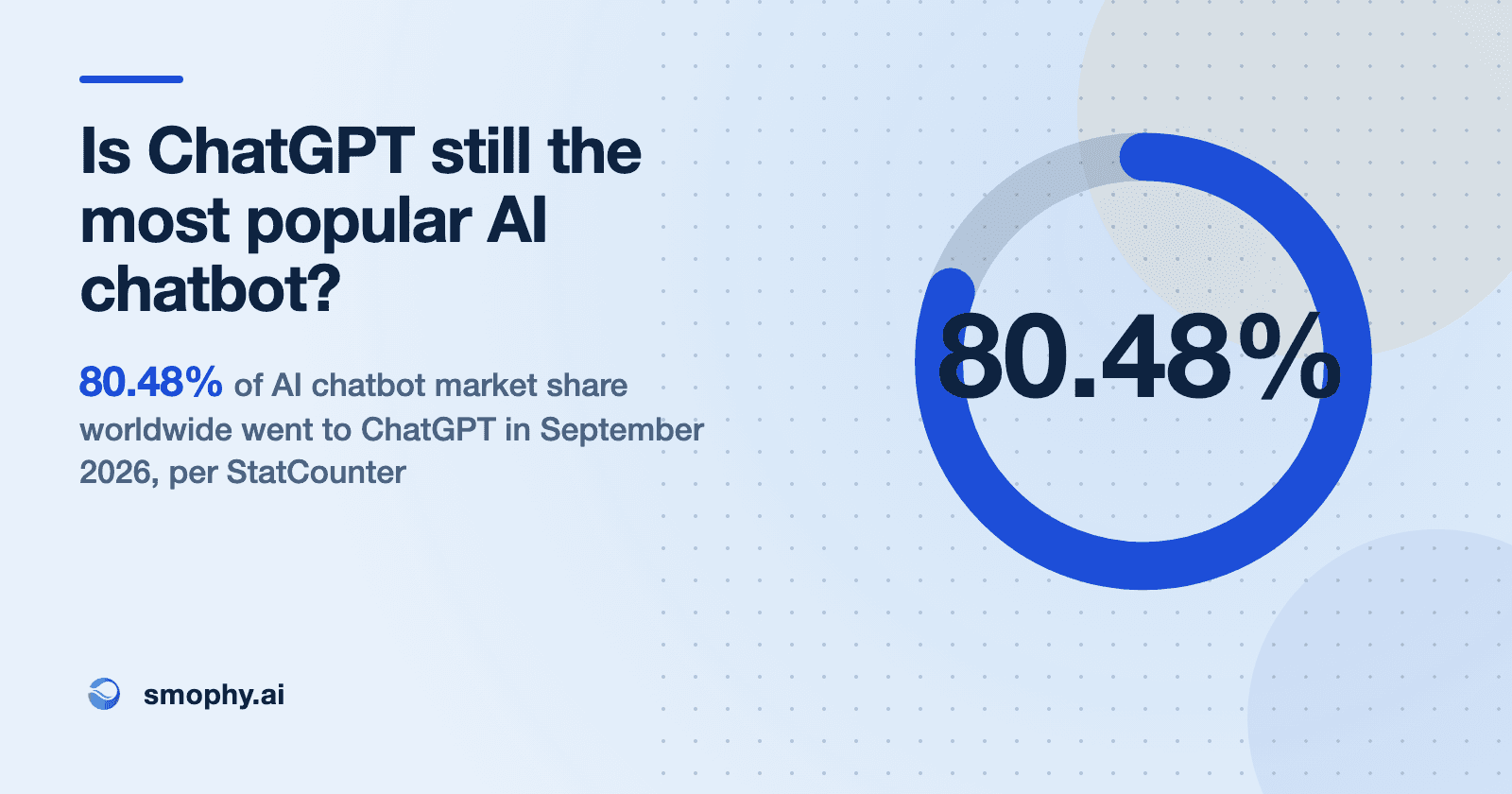
Yes, by a wide margin. StatCounter measured AI chatbot market share worldwide in September 2026 at 80.48% for ChatGPT, 10.91% for Google Gemini, 5.85% for Perplexity, 1.79% for Microsoft Copilot and 0.95% for Claude. Being the most used model is not the same as giving the best answer to your question, though, and in our own tests different models added ideas the others missed. The useful habit is to check a second answer on the decisions that matter.
How big is ChatGPT's lead?
ChatGPT is used far more than any other chatbot in StatCounter's data.
StatCounter put ChatGPT at 80.48% of AI chatbot market share worldwide in September 2026. In the same StatCounter measurement, Google Gemini had 10.91%, Perplexity 5.85%, Microsoft Copilot 1.79% and Claude 0.95%.
In practice, that means most people who use a chatbot see one model's answer, most of the time. For quick questions that works well. For decisions about money, customers or strategy, one answer is one view.
Does the most popular AI give the best answer?
Not on every question. In our own SmophyAI Pain Tests, the six models we compare often agreed on the direction and then differed on the details that make a plan work.
In SmophyAI Pain Test PT-08, six models looked at a nine person software company with one support person and four hundred tickets a month. All six proposed a help center for the repeated questions, routing of billing and bug tickets, and part time help. Then single ideas stood out. DeepSeek V4 Pro alone proposed fixing the product causes so the repeated questions stop for good. Grok 4.5 was the one model to propose moving onboarding off the support person. Claude Opus 5.5 and Sonar Reasoning Pro were the two that said to personally contact the two customers who cancelled.
None of those ideas came from the most popular model alone. Reading one answer would have shown you at most one of them.
Do other models add ideas the popular one does not?
They did in our tests, and often on the part of the plan that matters most.
In SmophyAI Pain Test PT-02, six models looked at a five person web design agency that sends about two hundred cold emails a month and gets about two replies. All six said to stop mass cold email and build trust through a niche and referral partners. Their diagnoses differed: Claude Opus 5.5 saw strangers asked to trust a large decision, GPT-6 Astra saw targeting who can pay instead of who has an urgent problem, and Grok 4.5 saw mass email that creates no trust or relevance. Sonar Reasoning Pro was the one model that turned the offer into a paid diagnostic for lost leads, credited toward the project.
In SmophyAI Pain Test PT-01, a consultant fully booked at an unchanged hourly rate wanted 30 percent more revenue within six months. GPT-6 Astra calculated that losing one equally sized client would require the remaining five to pay fifty six percent more, a number that changes how carefully you raise prices. Each answer was useful, and each one saw something the others did not.
When is one AI answer enough?
One answer is enough when the task is simple and easy to check.
- **Quick facts you can verify.** A date, a definition or a unit conversion you can confirm in seconds.
- **First drafts you will rewrite anyway.** An email outline or a list of headline ideas.
- **Small edits.** Fixing grammar or shortening a paragraph.
Second answers pay off when a mistake costs money or trust: pricing, hiring, customer policies, strategy and anything you will send to a client.
How do you compare AI answers on your own question?
The method is simple: the same prompt in several models, read side by side.
- **Write the question exactly as you would send it.** Include your real situation, with numbers and limits.
- **Send the identical prompt to several models.** Use fresh conversations so nothing else changes.
- **Write down what they all agree on.** That is your baseline.
- **Circle every idea that appears in only one answer.** Those are the options you would have missed.
- **Check the single ideas against your own cost and risk.** Try the cheapest one first.
What does comparing several models look like in one place?
SmophyAI is an AI workspace where ChatGPT, Claude, Gemini, Grok, Perplexity and DeepSeek answer the same prompt side by side in one subscription.
Multi-Chat sends one prompt to all six models at once, so the comparison above becomes one action instead of six tabs. Best Answer then combines the strongest information from the six responses into one reply. You keep ChatGPT in the lineup and add five other views next to it. The plan costs $19.98 a month, and you can start free with your own question.
Common questions
What is the most popular AI chatbot right now?
ChatGPT. StatCounter measured its share of AI chatbot market share worldwide at 80.48% in September 2026, ahead of Google Gemini at 10.91%.
Is ChatGPT the right AI for every question?
It is the most used, but in our tests other models added ideas it did not. In SmophyAI Pain Test PT-08, ideas such as fixing the product causes of repeated tickets came from DeepSeek V4 Pro alone.
What are the most used AI chatbots?
In StatCounter's September 2026 data, the order was ChatGPT, Google Gemini, Perplexity, Microsoft Copilot and Claude.
Can I use ChatGPT and other models together?
Yes. SmophyAI Multi-Chat sends one prompt to ChatGPT, Claude, Gemini, Grok, Perplexity and DeepSeek and shows the answers side by side for $19.98 a month.
Sources
About SmophyAI
SmophyAI is an AI workspace where ChatGPT, Claude, Gemini, Grok, Perplexity and DeepSeek answer the same prompt side by side in one subscription, with Best Answer, Smophy Mode routing and studios for images, video and writing. Try Multi-Chat
About the author. Kamil Kępiński is the founder of Smophy Labs Inc. and builder of SmophyAI.
Try SmophyAI today
One workspace for chat, images, video, writing, and business tools.
Start free with 10 messages, then upgrade from $19.98/month when you need more.
Start free at smophy.ai