
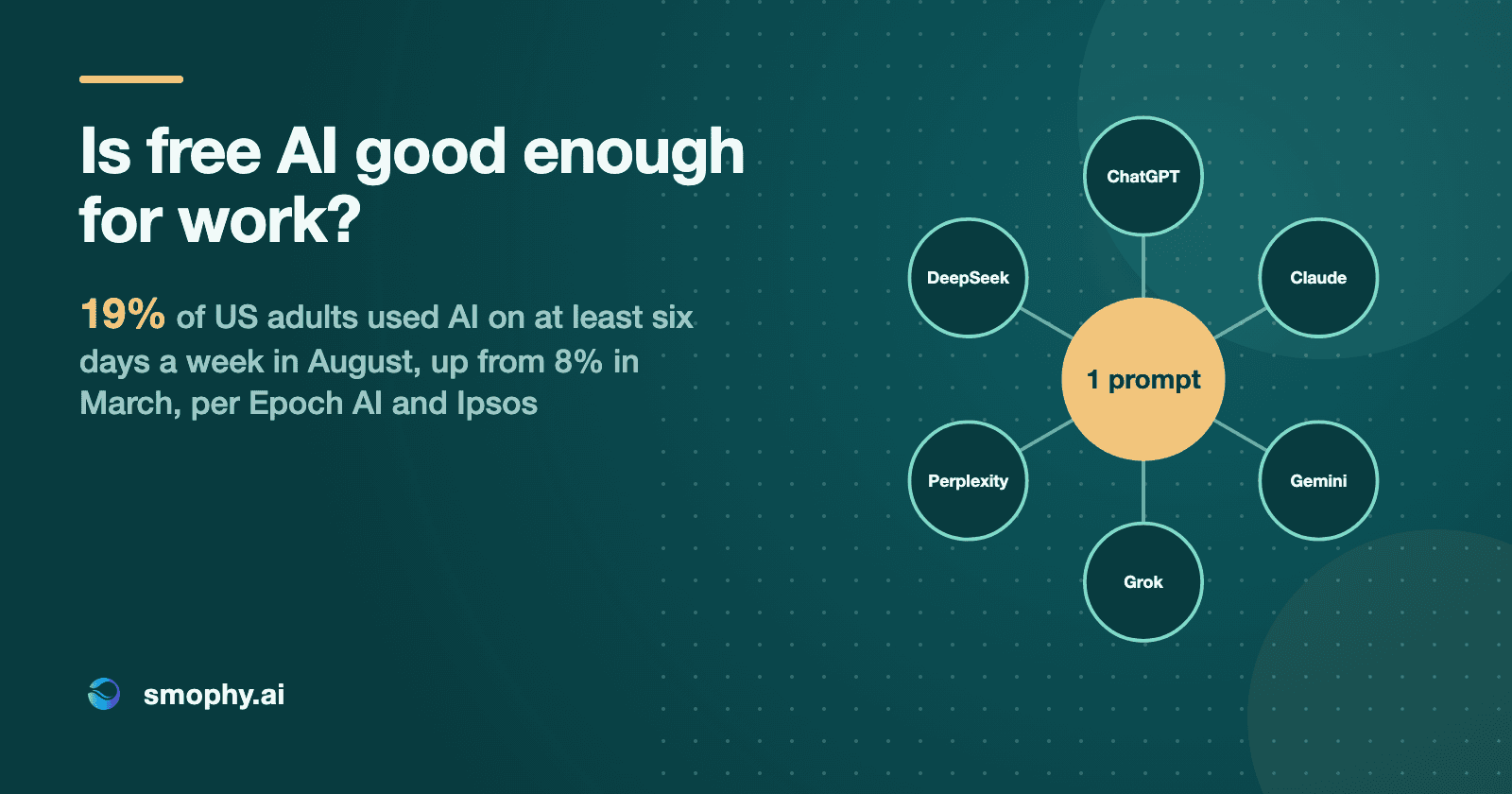
For occasional tasks, free plans are how most people already use AI at work. Epoch AI found that for most occupation groups, free plans are the most common way to access AI at work, used by 45% to 61% of workers. Free stops being enough when AI becomes a daily tool: limits start to interrupt work, and one model's answer becomes the one you rely on. The useful test is your own task, run on more than one model, before you pay for anything.
How do most people use AI at work today?
Mostly on free plans, with one clear exception.
Epoch AI's survey with Ipsos of 1,103 employed US adults found that for most occupation groups free plans are the most common way to access AI at work, at 45% to 61% of workers. The exception is computer, engineering and science jobs, where Epoch AI found that a majority, 67%, use an employer-provided subscription at least some of the time. Epoch AI put that share at 41% in management, business and arts.
So the people writing code and analysing data often get paid tools from their employer, while many people in business roles work with whatever is free.
Is AI becoming a daily habit?
For a growing group of people, yes.
Polling by Epoch AI and Ipsos found that the share of US adults who used AI at least six days in the previous week rose from 8% in March to 19% in August. Over the same months, Epoch AI found that the share using AI on just one day in the previous week fell from 17% to 10%.
Daily use changes the question. Once AI is part of the working day, the limits of a free plan stop being a rare annoyance and start to shape the work: a usage cap reached in the middle of a task, or a feature that only paid plans include.
What changes when AI does real tasks?
The quality of the first answer starts to matter more than the price of the plan.
Epoch AI found that 20% of employed US adults say AI now handles at least one task that was previously handed off to a coworker or contractor. Epoch AI also found that across AI-assisted tasks, 66% of outputs were used unchanged or with only minor edits.
That second number is the important one for anyone deciding whether to pay. When two thirds of outputs go out almost as written, the model that wrote them carries real weight. If it misses an idea or states something wrong with confidence, there may be no second look before the work is used.
Does one free model give you the full picture?
Not always, because models differ and even one model can change its answer.
Full Fact collected 7,625 chatbot responses from five widely used chatbots to the same 22 questions asked daily for 70 days, and found that models sometimes gave different answers to the same question on different days. In our own SmophyAI Pain Tests, six models often agreed on the direction of a business answer and then differed on the details. In SmophyAI Pain Test PT-07, about an overloaded store owner choosing between a first hire and automation, Gemini 4 Argon proposed recording two hours of the owner's own screen so the recording becomes the training manual for the future assistant.
Relying on one chat means relying on one model's view. For quick tasks that is fine. For decisions you will act on, a second answer is cheap insurance.
When is free AI enough, and when should you pay?
Free is enough while AI stays occasional; paying makes sense once it carries daily work.
- Count how often you use it. If you open an AI tool on most working days, you are already in the group Epoch AI saw growing.
- Note where the free plan stops you. Write down every time a limit or a missing feature interrupts a task.
- List the tasks that go out almost unchanged. Those are the ones where the model's quality matters most.
- Test those tasks on more than one model. Use the same prompt, written exactly as you would send it, in fresh conversations.
- Pay for what your tasks need. Choose the plan that covers the models that did best on your own work, not the one with the loudest launch.
How does SmophyAI fit this decision?
SmophyAI is an AI workspace where ChatGPT, Claude, Gemini, Grok, Perplexity and DeepSeek answer the same prompt side by side in one subscription.
Multi-Chat sends one prompt to all six models at once, so step four above becomes one action instead of six free accounts. Best Answer then combines the strongest information from the six responses into one reply. The plan costs $19.98 a month, and you can start free with your own question before deciding whether AI has become a daily tool for you.
Common questions
Is free AI good enough for work?
For occasional tasks, yes, and most people already work that way. Epoch AI found that for most occupation groups, free plans are the most common way to access AI at work, used by 45% to 61% of workers.
What is the difference between free AI and paid AI?
The difference that matters most for work is whether the model you use does well on your own tasks, which you can only see by testing them with the same prompt.
Is the paid version of AI worth it?
It is worth it when AI does daily work you rely on. Epoch AI found that 66% of outputs in AI-assisted tasks were used unchanged or with only minor edits, so the model behind those outputs carries real weight.
How can I compare AI models before paying?
Send the same prompt to several models and read the answers side by side. SmophyAI Multi-Chat does this for ChatGPT, Claude, Gemini, Grok, Perplexity and DeepSeek in one subscription.
Sources
About SmophyAI
SmophyAI is an AI workspace where ChatGPT, Claude, Gemini, Grok, Perplexity and DeepSeek answer the same prompt side by side in one subscription, with Best Answer, Smophy Mode routing and studios for images, video and writing. Try Multi-Chat
About the author. Kamil Kępiński is the founder of Smophy Labs Inc. and builder of SmophyAI.
Try SmophyAI today
One workspace for chat, images, video, writing, and business tools.
Start free with 10 messages, then upgrade from $19.98/month when you need more.
Start free at smophy.ai