
AI agents are AI tools that do a task for you instead of only answering when you ask. In everyday life that means work that waits for you: a morning briefing on your topics, an alert when something changes, or posts prepared in your style. People accept agents with conditions: Synchrony and Oxford Economics found that 43% of consumers are comfortable letting AI purchase up to a preset limit. The useful ones show sources, ask before acting and are easy to edit or pause.
What is an AI agent, in plain words?
Everyday chat works like a conversation. You ask, the model answers, and then it waits for your next message.
Agents work more like a helper with a standing job. You give a goal and a schedule once, and the agent does the steps on its own: it searches, compares, prepares and brings back the result.
The difference that matters for daily life is who starts the work. With chat, you start every time. With an agent, the work is ready when you sit down.
What can an AI agent do for you every morning?
The everyday jobs that suit an agent best are small, repeated tasks you can check quickly.
- Brief you on your topics. Your city, your team, your next trip or the news in your field, summarized at the time you choose, with a link to the source of every story.
- Speak up only when something changes. Instead of checking a page every day, you get an alert when there is something new on the topic you watch.
- Prepare content in your style. Post drafts with images, sized for the platforms you use, ready for you to edit and publish yourself.
- Handle small shopping chores. Synchrony and Oxford Economics found that 79% of consumers are willing to let AI automatically apply discounts, and 74% are willing to let it apply loyalty points or rewards.
Each of these saves the same kind of time: the minutes you spend opening tabs, searching and copying before the real work starts.
How much do people already let AI do for them?
More than many expect, but the stakes decide how far they go.
Forter found that 53% of holiday shoppers would be comfortable letting AI purchase a holiday gift autonomously, depending on the purchase amount.
Synchrony and Oxford Economics show the same pattern by price: for items under $50, 47% of consumers would let AI suggest options for review and approval, and 34% would let it act automatically based on their preferences and past behavior. At the other end, Synchrony and Oxford Economics found that 46% would not use AI for purchases of $5,000 or more.
The question is less whether an agent should help and more how much it should do on its own, and the answer moves with the size of the task.
What makes an AI agent safe to trust?
Proof, approval and control, in that order.
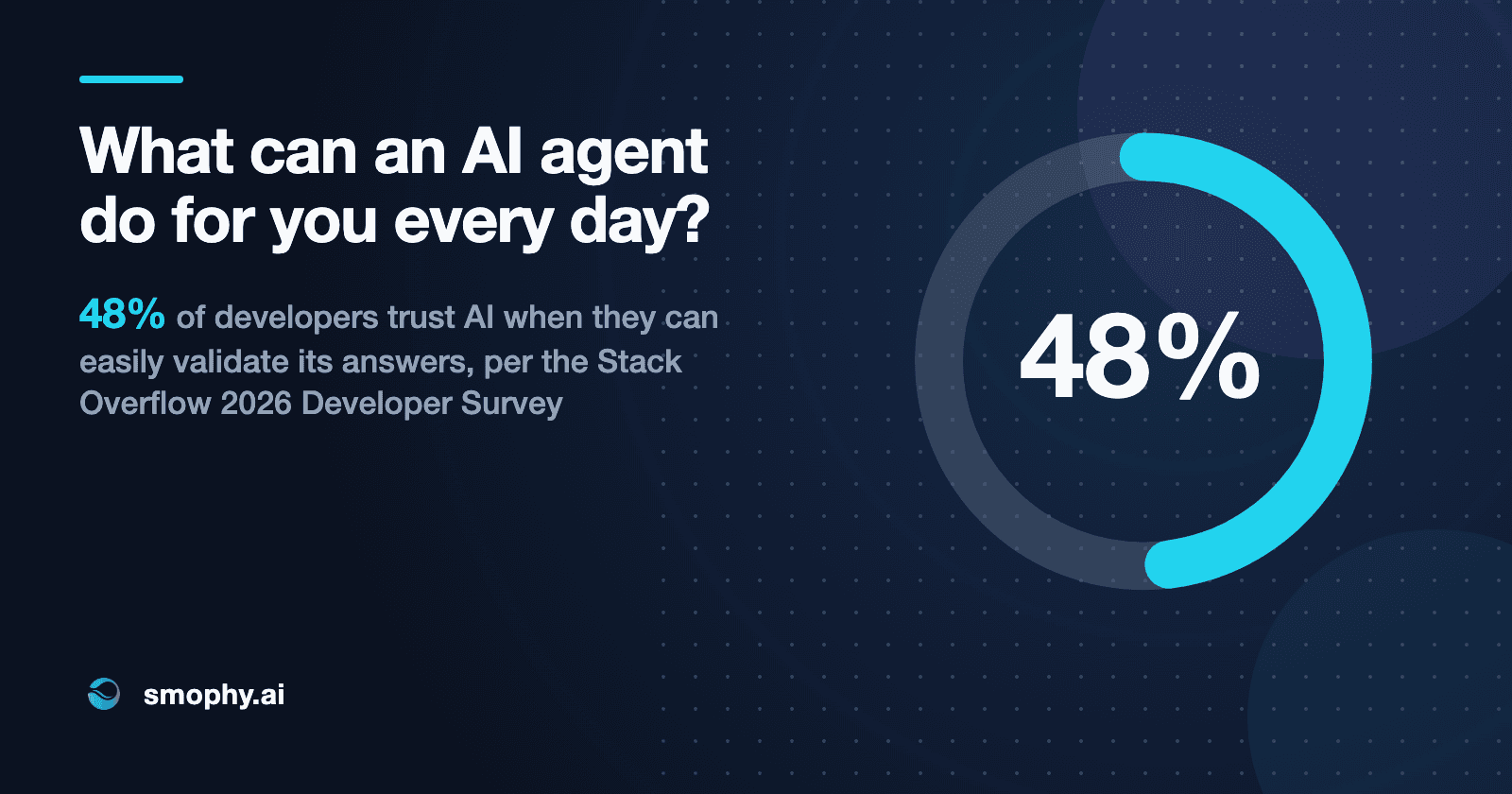
The Stack Overflow 2026 Developer Survey found that 48% of developers trust AI when they can easily validate the answers, and only 16% extend that trust to most tasks that are not important work decisions. In other words, trust follows the ability to check.
Shoppers say the same about actions. When Forter asked holiday shoppers what would make them more comfortable with autonomous gift purchases, they named requiring final approval before purchase (26%), setting spending limits (24%) and controlling what personal data AI can access (22%). Synchrony and Oxford Economics found that keeping data secure (82%) and transparency about how data is used (77%) rank above saving time (58%) in what consumers want from AI shopping.
Put together, a trustworthy everyday agent has five things:
- Sources on every item, so you can check any claim in one click.
- Approval before anything important, so it suggests and you decide.
- Clear limits, such as a topic list, a time or a spending cap.
- Edit and pause buttons, so you can change or stop it without starting over.
- History you can read, so you can see what it did and when.
How do you start with AI agents without losing control?
Start small, with work you already do by hand.
- Pick one repeated task. The morning news check or a weekly post plan are good first choices.
- Write down what a good result looks like. Which topics, how long, which sources you trust.
- Choose an agent that prepares, not one that acts. Let it suggest for your approval first.
- Ask for a source on every item. If it cannot show where a fact came from, treat the fact as unchecked.
- Check the model behind it. Send the same prompt to several models and compare the answers before you rely on one model's view.
- Keep the controls. Make sure you can edit, pause and review the history before you give it more freedom.
How does SmophyAI fit into this?
SmophyAI is an AI workspace where ChatGPT, Claude, Gemini, Grok, Perplexity and DeepSeek answer the same prompt side by side in one subscription.
We are building the next step of SmophyAI: a workspace that also works for you every day, not only when you ask. The update in development includes a new Home with two views, Today with everything SmophyAI prepared for you and Explore with every tool and a free ready example of each. It also includes a daily briefing on any topic, waiting at the time you choose with the source of every story, and alerts that speak up only when something new happens on a topic. Being built as well: a content assistant that prepares posts with images in your style for the platforms you pick, with daily post ideas, hooks and a 30 second Reel script. Every automation can be edited and paused and keeps its history, and an ideas box lets users suggest and vote for the next agents.
What works today is the part of step five above. Multi-Chat sends one prompt to all six models at once, so you can see where they agree and where one model adds something the others missed. You can start free with your own question.
Common questions
What is an AI agent in simple terms?
It is AI that does a task for you on a goal and a schedule you set, instead of waiting for each new question. Think of a morning briefing that is ready before you wake up.
What are some good examples of AI agents for daily use?
Daily briefings on your topics, alerts when something you follow changes, prepared post drafts and small shopping chores such as applying discounts. Synchrony and Oxford Economics found that 79% of consumers are willing to let AI automatically apply discounts.
Is it safe to let an AI agent act for me?
It is safer when the agent shows sources, asks for approval and has limits. Forter found that shoppers named final approval before purchase (26%) and spending limits (24%) as things that would make them more comfortable.
What is the difference between an AI chatbot and an AI agent?
Chatbots answer when you ask. Agents work toward a goal you set and bring back the result, often on a schedule.
Does SmophyAI have AI agents?
SmophyAI is building daily agents, such as a briefing and topic alerts, into its next update. Today you can use Multi-Chat to compare six models on the same prompt in one subscription.
Sources
About SmophyAI
SmophyAI is an AI workspace where ChatGPT, Claude, Gemini, Grok, Perplexity and DeepSeek answer the same prompt side by side in one subscription, with Best Answer, Smophy Mode routing and studios for images, video and writing. Try Multi-Chat
About the author. Kamil Kępiński is the founder of Smophy Labs Inc. and builder of SmophyAI.
Try SmophyAI today
One workspace for chat, images, video, writing, and business tools.
Start free with 10 messages, then upgrade from $19.98/month when you need more.
Start free at smophy.ai