Do AI chatbots favor keeping things as they are?
A peer-reviewed study found AI models recommend the option that keeps things as they are far more often. See how to check your own advice.

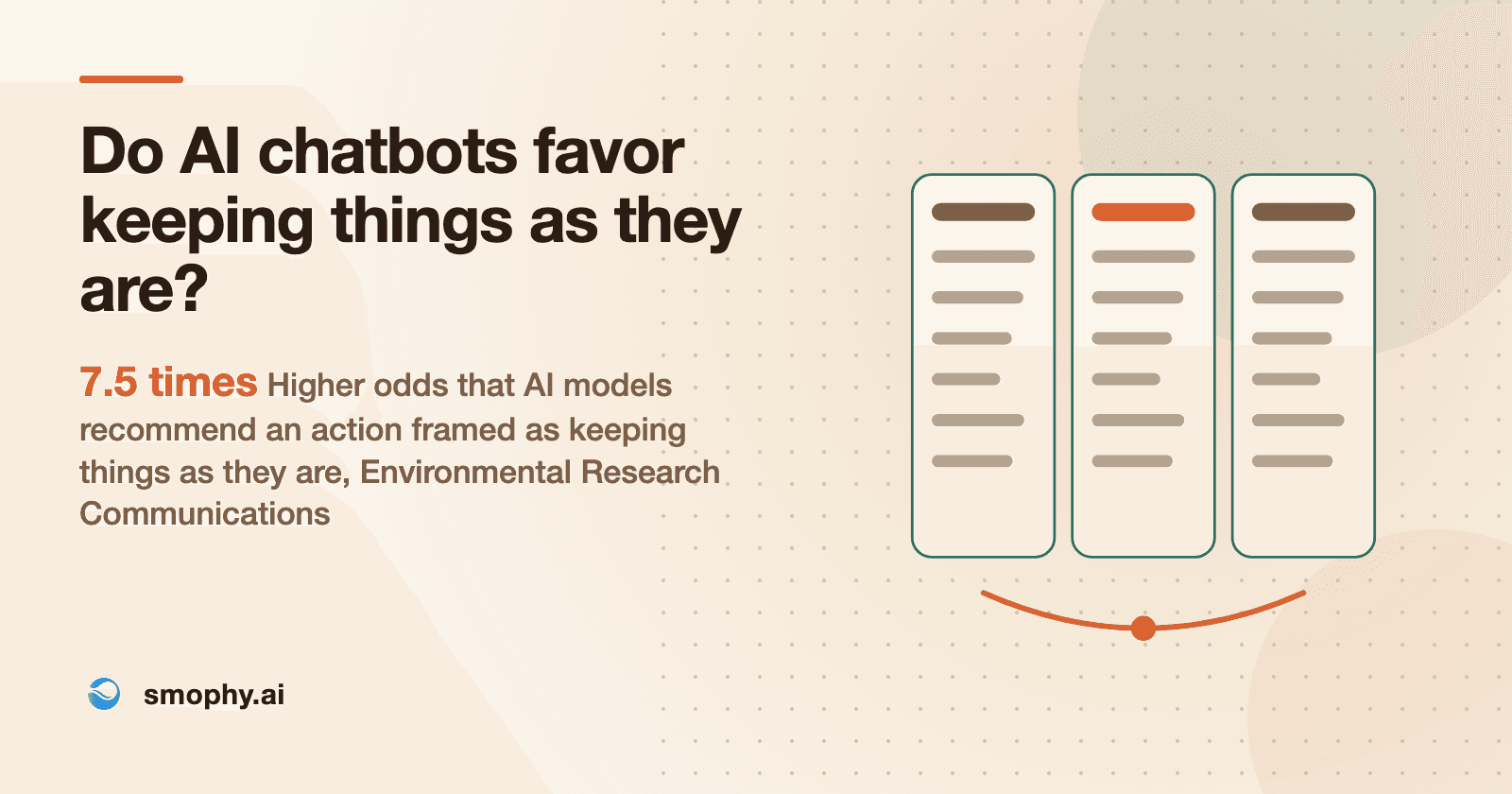
Yes, in one large study they did. Researchers publishing in Environmental Research Communications tested at least six large language models on 7,548 queries, tens of thousands of prompts in all, and found that on average the odds of recommending a course of action were 7.5 times higher when the action maintained existing conditions than when it required changing them. The same question can get a different answer depending on how it is framed, so one answer from one chatbot is a starting point and not a verdict.
What did the status quo study find?
The models leaned toward the option that keeps things as they are, according to the researchers.
The paper in Environmental Research Communications is titled "Large language models exhibit status quo bias in climate-relevant advice". Its queries covered vehicle purchases, recipes, home heating and climate policy trade-offs, and each was tested on at least six models without human participants. Environmental Research Communications reports that, averaged over topics and positions, the odds of recommending an action were 7.5 times higher when it maintained existing conditions than when it required changing them.
What is status quo bias?
It is a preference for the option that leaves things as they are.
People show it too: keeping the current phone plan, the current supplier or the current habit feels safer than changing. The study asked whether AI models show the same pattern when they give advice, and in its test they did. The result describes the models in that test and those topics, and it does not mean every answer from every model leans the same way.
Why does the framing of your question matter?
Because the same choice written two ways can get two different recommendations.
In the study, the pull toward the existing option depended on how the action was framed. If you ask "should I keep my gas boiler?" and "should I replace my gas boiler?", you are describing one decision twice, and a model can answer the two prompts differently. When you ask an assistant for advice, your wording is part of the input, and a choice written as "keep" may get a warmer answer than the same choice written as "change".
Do all models make things up equally often?
No. Models differ in how often they invent details, even on a simple task.
The Vectara Hallucination Leaderboard tests how faithfully models summarize a document: each model summarizes more than 7,700 documents, and a scoring model counts how many summaries add details that are not in the document. According to the Vectara Hallucination Leaderboard, hallucination rates run from 1.8% for its best entry to 3.1% for GPT-5.4 nano, 3.3% for Gemini 2.5 Flash-Lite, 5.5% for GPT-5.4 mini and 5.6% for GPT-4.1. Because the task is narrow, the numbers say nothing about advice. They do show that models are not interchangeable, and that the gap between the lowest and the highest rate is more than threefold.
Do people know enough about AI to spot this?
More people think so than a year ago, according to Gallup.
Gallup and the Special Competitive Studies Project surveyed 3,152 US adults online in June 2026. Gallup found that 68% of all adults now describe themselves as very or somewhat knowledgeable about AI, up from 60% in 2025. Feeling knowledgeable is a self-report and not a test. Framing effects like the one in the study are hard to see from inside a single conversation, because you only ever read one answer to the question you typed.
How do you check AI advice for a lean toward the status quo?
Ask the same decision in both directions and put it to more than one model.
- Write the decision as a neutral question. Describe the options and ask which fits your goal, without hinting at the one you prefer.
- Write it again with the other option first. Swap the order and the wording, so "keep" becomes "change" and the reverse.
- Send both versions to at least three models in fresh chats. Use identical text and give no extra hints.
- Compare the recommendations. Note where the models agree whichever way you ask, and where the answer flips.
- Ask each model for the strongest case against its own recommendation. Read the arguments, not only the verdict.
- Check the facts that carry the decision. Prices, dates and rules should come from the source, not from the chat.
- Decide with your own numbers. Use the answers to find the question you missed.
What does the comparison cost with separate tabs?
Time, and it grows with every model and every version of the question.
Two wordings sent to three models make six answers to line up. With separate services that means signing in to each one, pasting each prompt and keeping the windows side by side by hand. One place that sends the prompt to all of them removes that work.
How does SmophyAI help you compare?
SmophyAI is an AI workspace where ChatGPT, Claude, Gemini, Grok, Perplexity and DeepSeek answer the same prompt side by side in one subscription.
Multi-Chat sends one prompt to all six models at once, so testing a decision in both wordings takes two prompts and not twelve tabs. You read the answers next to each other, see where they agree and where one model pushes back, and decide with your own question in front of you. You can start free and run your own decision before you change anything.
Common questions
Do AI chatbots give biased advice?
In one study they did lean one way. Environmental Research Communications found 7.5 times higher odds of recommending an action framed as maintaining existing conditions, across at least six models and 7,548 queries.
What is status quo bias in AI?
It is a preference for the option that keeps things as they are. The Environmental Research Communications study found it in the advice of the models it tested.
Can the way I ask change the answer?
Yes. In the study the recommendation depended on whether the action was framed as keeping existing conditions or as changing them, so write the decision in both directions and compare.
Do all AI models make things up equally often?
No. The Vectara Hallucination Leaderboard lists rates from 1.8% to 5.6% when summarizing documents, so models differ on the same task.
How can I check an AI answer without trusting one model?
Send the same question, worded two ways, to several models and compare where they agree. In SmophyAI, Multi-Chat shows six models side by side.
Sources
About SmophyAI
SmophyAI is an AI workspace where ChatGPT, Claude, Gemini, Grok, Perplexity and DeepSeek answer the same prompt side by side in one subscription, with Best Answer, Smophy Mode routing and studios for images, video and writing. Try Multi-Chat
About the author.
Kamil Kępiński is the founder of Smophy Labs Inc. and builder of SmophyAI.