Why do AI market share numbers disagree?
Graphite and Similarweb put ChatGPT at 81.2% of chatbot sessions, a Similarweb tracker at 55.7% of traffic. See what each counts and how to choose an AI.

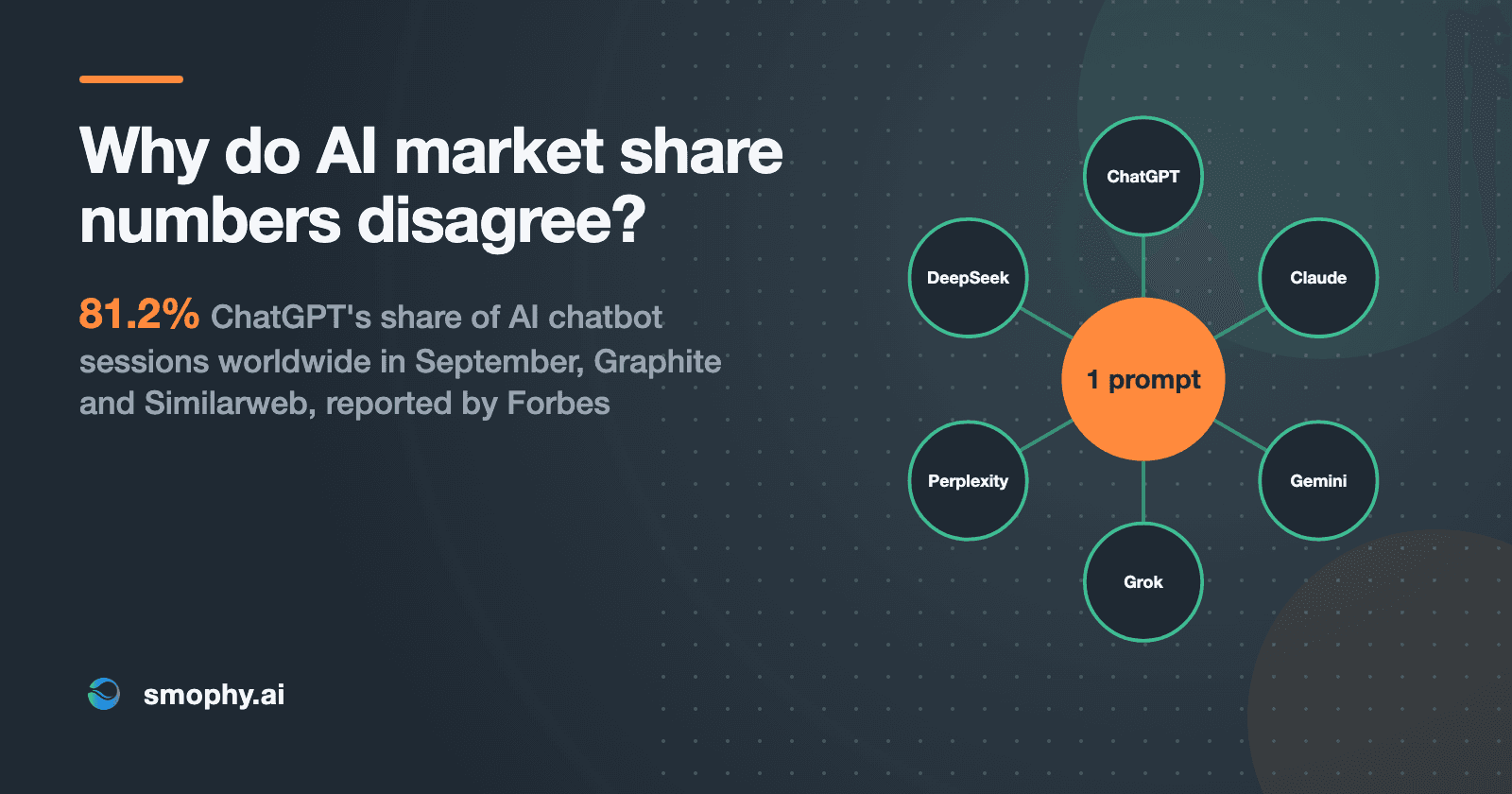
Because each study counts something different. Forbes reported that a Graphite and Similarweb study found ChatGPT accounted for 81.2% of all AI chatbot sessions worldwide in September. OfficeChai reported that Similarweb's generative AI traffic tracker put ChatGPT at 55.7% of worldwide website traffic in October, and Comscore found that ChatGPT's share of total AI prompt volume fell to 50% in June. The numbers are all real, and none of them tells you which assistant is best for your work.
What do the different market share numbers say?
They give ChatGPT a share anywhere from half to more than four fifths, depending on what is measured.
Forbes reported that a study by Graphite and Similarweb found ChatGPT accounted for 81.2% of all AI chatbot sessions worldwide as of September, a rebound from an all-time low of 80.42% in June. According to Forbes, none of ChatGPT's competitors had reached 10% of chatbot market share in that study.
OfficeChai reported a different picture from Similarweb's generative AI traffic tracker. In OfficeChai's report, ChatGPT slipped to 55.7% of worldwide website traffic in October, Gemini fell to 24.2% and Claude rose to 11.5% from 9.6% in September.
Comscore panel data showed ChatGPT's share of total AI prompt volume falling from 70% in January to 50% in June, while Gemini rose from 17% to 30% and Claude from 2% to 11%.
Why can one assistant have two very different shares?
Because the two figures measure different things in different sets of products.
Forbes reports the first figure as a share of AI chatbot sessions. OfficeChai reports the second as a share of worldwide website traffic in a generative AI tracker, and Comscore's number is a share of prompt volume taken from a panel of users. Sessions, website visits and prompts are three different units, and each study also chooses which assistants to include.
The gap is easy to see on Gemini. In the Graphite and Similarweb report as covered by Forbes, no competitor of ChatGPT had reached 10%. In the Similarweb tracker as covered by OfficeChai, Gemini held 24.2% in October. Both can be correct, because they describe different groups of products and different counts.
So treat each number as an answer to its own question, and never put them on one chart.
Do the numbers show the same trend?
Not always, which is one more reason to read each source on its own terms.
Comscore found ChatGPT's share of prompt volume falling from 70% to 50% in six months, and OfficeChai reported Claude rising to 11.5% of traffic in the Similarweb tracker. Forbes, however, reported that ChatGPT recovered some share from its June low of 80.42% in the Graphite and Similarweb data, while OfficeChai reported a small slip for ChatGPT in October.
Each source shows its own movement, so compare a number only with an earlier number from the same source.
What should the number change in your choice of AI?
Very little, because market share is a map of where people go and not a measure of how good an answer is.
Share of sessions, visits or prompts tells you how often an assistant is opened. It does not tell you whether its answer to your customer email, your report summary or your piece of code is the best one. The only test that answers that is your own prompt.
Three rules keep you out of the trap:
- Read the unit before the number. Check whether a figure counts sessions, visits, prompts or users.
- Compare numbers from one source and one period. Mixed sources can show the same assistant gaining and losing at once.
- Decide by your own task. Take the three prompts you use most and run them on the assistants you are choosing between.
How can you test your own prompt without paying for several tools?
Send the same prompt to every assistant you are considering and read the answers side by side.
- Pick three prompts from your real work. Use a task you repeat, such as a customer email, a summary or a plan.
- Send identical wording to each assistant. Then the only difference is the assistant.
- Read where the answers agree first. Then look at where they differ.
- Check the claims that appear in only one answer. Ask the assistant for its sources and open the pages.
- Repeat when a new model arrives. Rerun the same three prompts and compare them with the last round.
How does SmophyAI help?
SmophyAI is an AI workspace where ChatGPT, Claude, Gemini, Grok, Perplexity and DeepSeek answer the same prompt side by side in one subscription.
Multi-Chat sends one prompt to all six models at once, with live web search on by default. You read the answers next to each other, ask each model to name its sources, open the pages behind the claims that differ and use Best Answer to combine the strongest information from the six responses into one draft. You can start free and test your own question before you decide which assistant to rely on.
Common questions
What is ChatGPT's market share?
It depends on what is counted. Forbes reported that a Graphite and Similarweb study found 81.2% of AI chatbot sessions worldwide in September, while OfficeChai reported that Similarweb's tracker put ChatGPT at 55.7% of website traffic in October.
Why do AI market share numbers differ?
Each study measures a different unit, such as sessions, website traffic or prompt volume, and chooses a different set of assistants. Comscore, for example, measured share of prompt volume and found ChatGPT at 50% in June.
Is Claude gaining on ChatGPT?
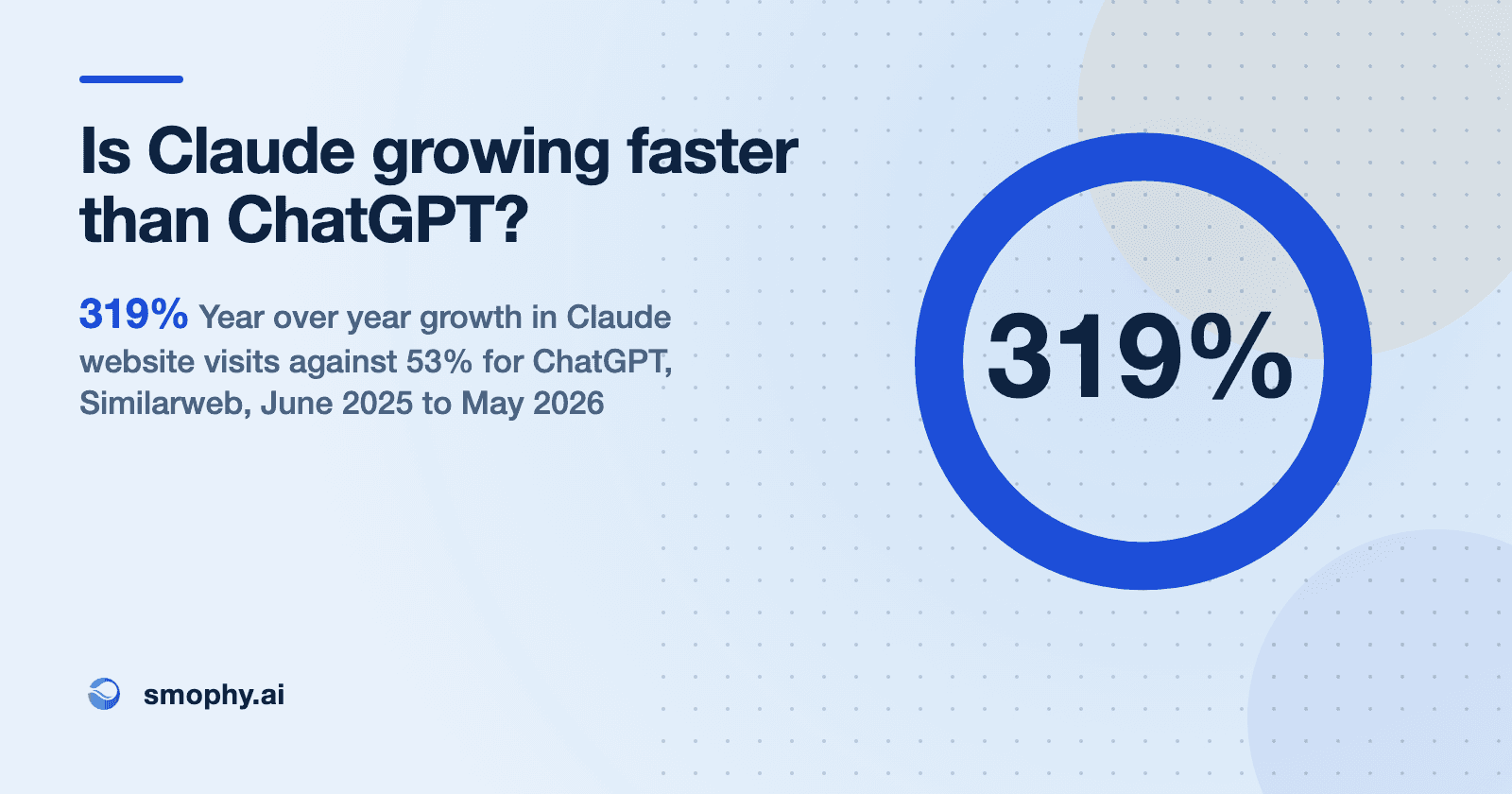
Yes in the sources above. OfficeChai reported Claude at 11.5% of worldwide website traffic in October, up from 9.6% in September, and Comscore found Claude's share of prompt volume rising from 2% to 11%.
Does a bigger market share mean a better AI?
No. Market share counts how often an assistant is used and says nothing about how good its answer is for your task.
How can I compare ChatGPT, Claude and Gemini on my own work?
Send the same prompt to each and read the answers next to each other. In SmophyAI, Multi-Chat shows six models side by side.
Sources
About SmophyAI
SmophyAI is an AI workspace where ChatGPT, Claude, Gemini, Grok, Perplexity and DeepSeek answer the same prompt side by side in one subscription, with Best Answer, Smophy Mode routing and studios for images, video and writing. Try Multi-Chat
About the author.
Kamil Kępiński is the founder of Smophy Labs Inc. and builder of SmophyAI.