
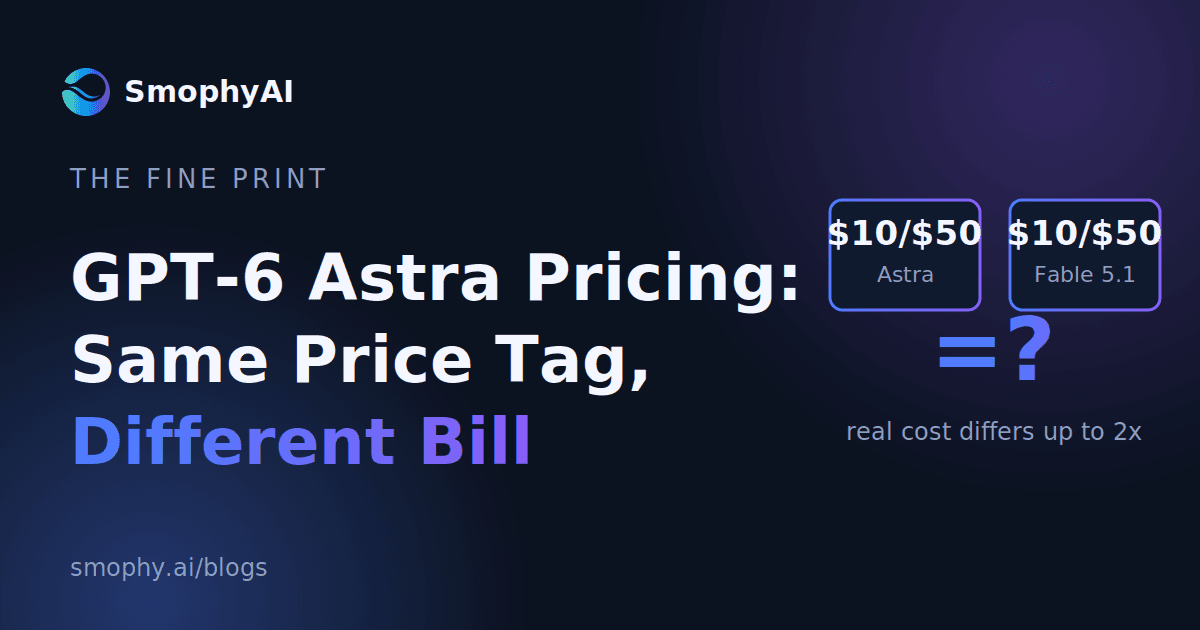
GPT-6 Astra and Claude Fable 5.1 have exactly the same list price: $10 per million input tokens, $50 per million output. And yet their real costs differ by up to 2x in both directions, depending on your workload. Three things the pricing page won't emphasize: Astra's cached input costs 4x more than Claude's ($1.00 vs $0.25 per million), Astra's rates double above 272K input tokens ($20 in / $75 out), and independent measurements show Astra completing benchmark tasks at roughly half Fable 5.1's total cost anyway - because it uses fewer tokens to get there. Identical price tags, completely different bills.
Here is what each line of fine print means for your invoice.
The full price sheet (as of September 10, 2026)
| Metric | GPT-6 Astra | Claude Fable 5.1 |
|---|---|---|
| Input / 1M tokens | $10.00 | $10.00 |
| Output / 1M tokens | $50.00 | $50.00 |
| Cached input / 1M | $1.00 | $0.25 |
| Above 272K input tokens | $20.00 in / $2.00 cached / $75.00 out | standard rates, no surcharge |
| Max context | 1.05M tokens | 1M tokens |
| Measured cost per completed task | ~$1.67–$3.26 | ~$3.76–$7.63 |
(The cost-per-task ranges span two independent methodologies; both agree on the direction and the roughly 2x gap.)
Fine print #1: the cache gap compounds
Cached input is what you pay when the model re-reads context it has already seen - and context gets re-read on every turn of a conversation. For a long working session or a chatbot serving repeat context, cached tokens quickly become the majority of the bill.
At $0.25 vs $1.00 per million, Claude's cache is 4x cheaper. A workload that is 80% cache reads - entirely normal for document Q&A or agent loops - costs meaningfully less on Fable 5.1 even though every headline number matches.
Fine print #2: the 272K cliff
Above 272K input tokens, Astra switches to $20/$75 rates - double the sticker price. That threshold sounds exotic until you do the conversion: 272K tokens is roughly 200,000 words, or a few large PDFs plus conversation history. Long-context retrieval workloads cross it routinely.
Claude Fable 5.1 charges flat rates across its full 1M window. If your use case lives in long context, this single line item can dominate the comparison.
Fine print #3: cheaper per task despite equal rates
Here is the twist that makes the first two caveats incomplete: on standardized task suites, Astra finishes work at roughly halfFable 5.1's measured cost - $1.67 vs $3.76 per task in one methodology, $3.26 vs $7.63 in another. Same rates, half the bill.
The reason is token efficiency. Astra solves problems in fewer reasoning steps and fewer written tokens (which independent reviewers note also makes its reasoning harder to monitor - fewer steps to audit). Fable 5.1's measured costs also carry a quirk of its own: roughly 4% of its output tokens get routed to fallback models by safety systems, and those tokens still bill.
The lesson generalizes: per-token prices don't predict per-task costs. How many tokens a model burns to finish the job matters more than what each token costs.
So which one is cheaper? It depends on the shape of your work
- Bursty, task-based work (solve, deliver, done): Astra, thanks to token efficiency.
- Long conversations, document Q&A, agent loops with heavy context reuse: Fable 5.1, thanks to 4x cheaper cache.
- Long-context retrieval above ~200K words: Fable 5.1, to avoid the 272K surcharge.
- Routine work that doesn't need frontier quality: neither - GPT-5.6 Sol at $5/$30 or cheaper tiers, as we argued in the full model comparison.
Which is, once again, a routing table. The cheapest AI bill in 2026 doesn't come from picking the cheapest model - it comes from sending each task to the model that finishes it in the fewest expensive tokens. That is the same pattern we cover in the real cost of AI subscriptions.
Skip the spreadsheet:SmophyAI's Smophy Mode routes each prompt to the most cost-effective model that can handle it, across GPT-6 Astra, Claude Fable 5.1 and four other frontier models - one subscription, one token pool. See how routing works →
FAQ
How much does GPT-6 Astra cost via API?
$10 per million input tokens and $50 per million output, with cached input at $1.00 per million. Above 272K input tokens, rates rise to $20/$75.
Is GPT-6 Astra cheaper than Claude Fable 5.1?
Per token: identical. Per completed task: usually yes, by roughly 2x, because it uses fewer tokens. Per long-context or cache-heavy workload: usually no - Claude's 4x cheaper cache and flat long-context pricing win there.
What is the 272K token threshold?
The input size above which Astra's pricing doubles. It equals roughly 200,000 words of context - large document sets and long-running agent sessions cross it regularly.
Why do measured costs per task differ between sources?
Different reasoning-effort settings and task suites. The absolute numbers vary; the ~2x Astra advantage on task-based work is consistent across methodologies.
Tags
Try SmophyAI today
One workspace for chat, images, video, writing, and business tools.
Start free with 10 messages, then upgrade from $19.98/month when you need more.