
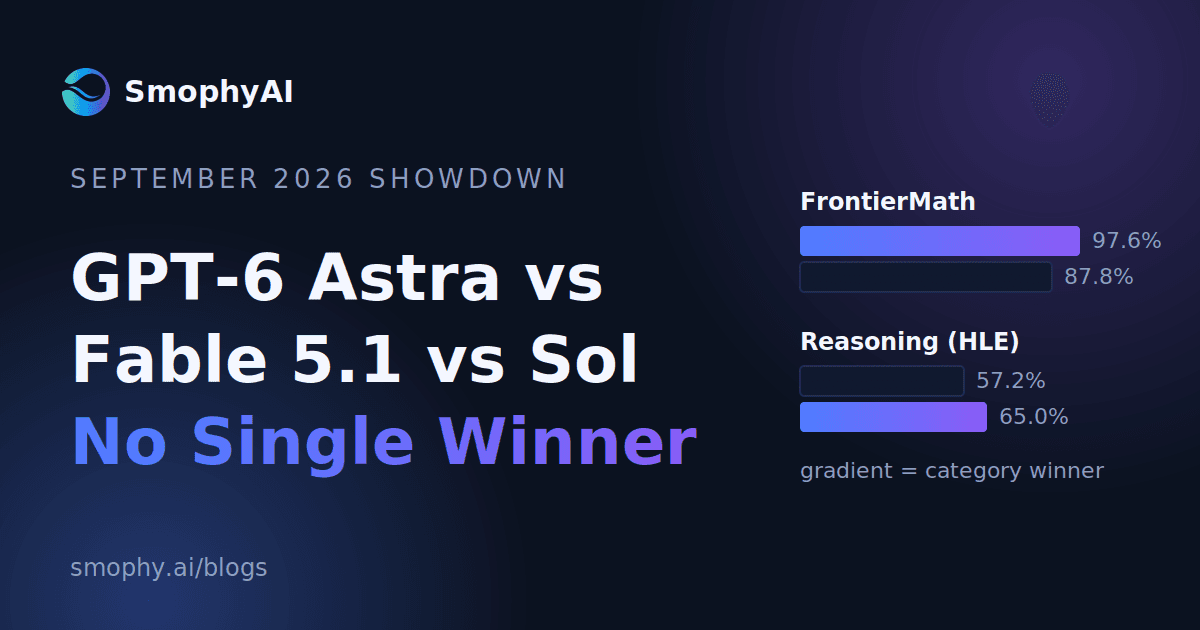
GPT-6 Astra, released September 4, beats Claude Fable 5.1 decisively in math, science and computer-use benchmarks (FrontierMath 97.6% vs 87.8%, ScreenSpot-Pro 92.7% vs 87.3%). Claude Fable 5.1 keeps the lead in deep reasoning with tools (Humanity's Last Exam 65.0% vs 57.2%) and raw output speed (67 vs 54 tokens/sec). Both charge exactly $10/$50 per million tokens - and both leave GPT-5.6 Sol, the headline release of just two months ago, in the role of the budget option at roughly half the price. There is no single winner: for the first time, the honest answer is one model per task type.
Here is the full breakdown, with a caveat most comparisons skip: independent benchmark scores for these models vary with reasoning-effort settings, so where measurements disagree, we show it.
The benchmark table (as of September 10, 2026)
| Benchmark | GPT-6 Astra | Claude Fable 5.1 | Winner |
|---|---|---|---|
| FrontierMath Tier 4 | 97.6% | 87.8% | Astra |
| GPQA Diamond (science) | 96.0% | 93.7% | Astra |
| Terminal-Bench Science | 64.6% | 52.6% | Astra |
| ScreenSpot-Pro (computer use) | 92.7% | 87.3% | Astra |
| BenchCAD (technical artifacts) | 95.9% | 84.3% | Astra |
| Humanity's Last Exam (with tools) | 57.2% | 65.0% | Fable 5.1 |
| SciCode | 56% | 63% | Fable 5.1 |
| Output speed | 54 tok/s | 67 tok/s | Fable 5.1 |
Two patterns jump out. First, the models split by task type, not by rank: Astra dominates structured, verifiable work (math, science, driving a computer, generating technical artifacts), while Fable 5.1 holds the messy-reasoning crown - long, tool-assisted problems where the path matters as much as the answer. Second, the gaps are real but narrow in most categories; the 10-point FrontierMath gap is the exception, not the rule.
Where does GPT-5.6 Sol land? Behind both on frontier benchmarks - it was already trailing Claude's Fable line on coding back in July (64.6% vs 80.3% on SWE-bench Pro) - but Sol costs roughly halfof what the new pair charges, which makes it the value pick for everyday work rather than obsolete. More on Sol's tiers in our GPT-5.6 guide. For the earlier coding-model snapshot, see Claude Fable 5 vs Sonnet 5 vs GPT-5.6 Sol.
Pricing: identical on paper, different in practice
| Metric | GPT-6 Astra | Claude Fable 5.1 | GPT-5.6 Sol |
|---|---|---|---|
| Input / 1M tokens | $10.00 | $10.00 | $5.00 |
| Output / 1M tokens | $50.00 | $50.00 | $30.00 |
| Cached input / 1M | $1.00 | $0.25 | - |
| Long-context surcharge | above 272K: $20 in / $75 out | none | none |
| Context window | 1.05M tokens | 1M tokens | 1M tokens |
The list prices are a coin flip. The fine print is not: Claude's cache reads are 4x cheaper, which matters enormously for long conversations and document work (context gets re-read on every turn), while Astra doubles its rates above 272K input tokens - a threshold long-context workloads hit routinely. Meanwhile, independent cost-per-completed-task measurements put Astra at roughly halfFable 5.1's real cost despite identical rates, because it solves problems in fewer steps and fewer tokens. We unpack all of this in GPT-6 Astra pricing: the fine print.
Which model for which task
- Math, data analysis, scientific work: Astra, and it is not close.
- Agent-style computer use, CAD, structured outputs: Astra.
- Long research sessions, ambiguous multi-step reasoning, tool orchestration: Fable 5.1.
- Long documents and long-running conversations: Fable 5.1 - the 4x cheaper cache and flat long-context pricing compound fast.
- Everyday drafting, summaries, routine questions: GPT-5.6 Sol or cheaper tiers - paying frontier rates for routine work is the most common money leak in AI right now.
If that list looks like a routing table, that's because it is one. The era of "pick the best model" ended somewhere around the moment two frontier models started winning different halves of the benchmark suite. What's left is matching each task to the model that wins it - manually, or automatically.
Compare them yourself: SmophyAI runs GPT-6 Astra, Claude Fable 5.1, Gemini, Grok, DeepSeek and Perplexity side by side on the same prompt - one subscription, one token pool, no per-model caps. The free tier needs no credit card. Run your own comparison →
FAQ
Is GPT-6 Astra better than Claude Fable 5.1?
At math, science and computer-use tasks, yes, by clear margins. At deep tool-assisted reasoning, no - Fable 5.1 leads Humanity's Last Exam by about 8 points. Neither wins overall; they win different task types.
Should I switch from GPT-5.6 Sol to GPT-6 Astra?
Only for work where the benchmarks above show a real gap. Sol costs about half as much, and for routine tasks the quality difference is hard to notice. Frontier models earn their price on frontier problems.
How much does GPT-6 Astra cost?
$10 per million input tokens and $50 per million output tokens via API - identical to Claude Fable 5.1's list price. The differences are in caching ($1.00 vs Claude's $0.25) and the long-context surcharge above 272K tokens.
Is GPT-6 Astra available in ChatGPT?
Yes - it rolled out to paid ChatGPT plans (Plus, Pro, Business, Enterprise) and the API (gpt-6-astra) in early September 2026. For enterprise workspaces it ships off by default until an admin enables it.
Why do benchmark scores for these models differ between websites?
Reasoning-effort settings. Both models expose adjustable effort levels, and independent labs test different configurations - the same model can score several points apart across sources. Directional conclusions (who wins which category) are consistent; exact numbers vary.
Tags
Try SmophyAI today
One workspace for chat, images, video, writing, and business tools.
Start free with 10 messages, then upgrade from $19.98/month when you need more.