How much does the average person use ChatGPT?
Epoch AI data shows median ChatGPT use rose from 14 to 36 messages a month, and the top 10% sent 63% of prompts. What heavy users do differently.

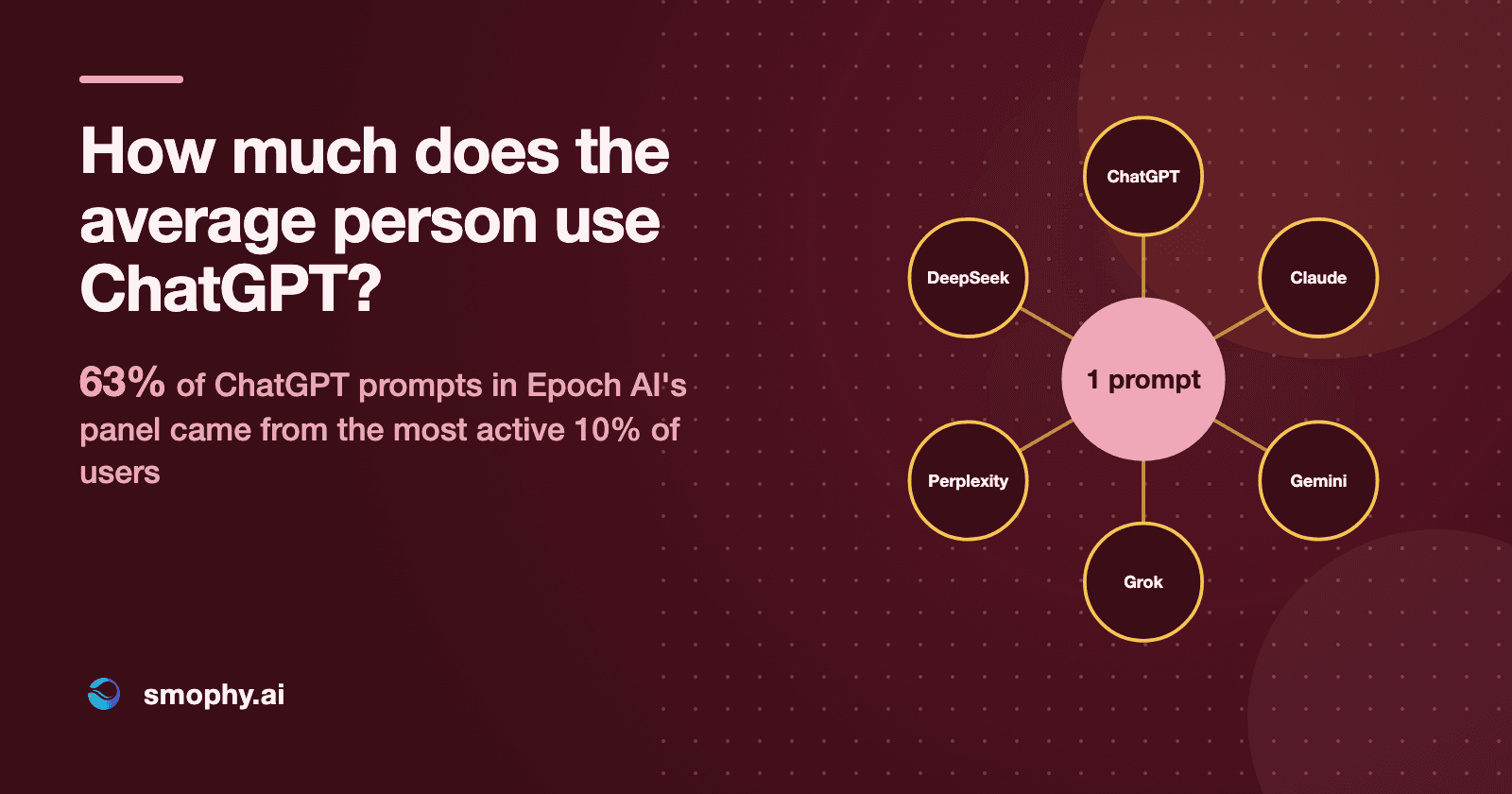
More than a few years ago, and a small group uses it far more than everyone else. In Epoch AI's ChatGPT usage data, the median number of messages per active panelist rose from 14 a month in January 2023 to 36 in December 2025, and the most active 10% of panelists sent 63% of prompts. Among these active users, use did not fade: it got deeper, and heavy users set the pace.
Is ChatGPT usage declining?
Not among Epoch AI's active panelists. Their data points the other way.
Epoch AI built its ChatGPT usage explorer from the chat metadata of US YouGov panelists who opted in to share their histories, covering the period from ChatGPT's launch to December 2025. Epoch AI received only the metadata, not the text of the messages, and it notes that the panel is not a representative sample of all US adults.
In Epoch AI's data, the median number of monthly messages per active panelist rose from 14 in January 2023 to 36 in December 2025. In that panel, the middle user did not drop the tool after the first wave of curiosity, but came back more often.
Daily use is also common across the population. Pew Research Center found that around half of US adults say they use AI chatbots, including 24% who say they use them daily.
Who uses ChatGPT the most?
Heavy users, by a wide margin.
In Epoch AI's data, the most active 10% of panelists sent 63% of prompts. The typical user and the heavy user live in different worlds: in Epoch AI's sample, the median panelist sent 36 messages in December 2025, while the top tenth of panelists sent most of all the prompts.
That gap matters for anyone who wants to get more from AI. If you use AI every day, the habits that make it pay off are different from the habits of someone who asks an occasional question.
Do most people prefer ChatGPT?
The largest group does, with about a third of AI users.
YouGov found that 33.7% of US adults who used generative AI in the past 30 days prefer ChatGPT most, 18.2% prefer Gemini, 8.2% Copilot and 6.1% Claude. ChatGPT leads, and the remaining preferences split across Gemini, Copilot, Claude and other tools.
So no single assistant is everyone's favorite. Your own choice is worth testing on your own work rather than taking from a ranking.
Which AI providers do businesses pay for?
Anthropic and OpenAI, at close shares.
The Ramp AI Index tracks what US businesses on Ramp pay for AI. In September 2026, AI adoption reached 55.9% of US businesses on Ramp, with 43.8% paying for Anthropic and 40.6% paying for OpenAI. Both providers reach more than four in ten businesses on Ramp, and neither is far ahead.
For an individual user, the useful habit is to check which model does each of your jobs best instead of staying with one by habit.
What do daily AI users need to trust an answer?
Among developers, sources come first.
The Stack Overflow 2026 Developer Survey found that 73% of respondents who use AI coding assistants or agents use them daily, and that to trust what the AI gives, 93% need source attribution.
The same habit works outside code. When an answer carries a number, a date or a recommendation you will act on, open the source, and when two models disagree, treat the difference as a reason to look closer.
How can you get more from ChatGPT if you use it every day?
Turn your repeated chats into a small system.
- Look at what you already ask. Read last week's chats and group them into a few jobs you repeat, such as replies, summaries, plans or research.
- Keep one tested prompt per job. Save the version that gives the context, the length and the tone you want, so every chat starts from a good draft.
- Compare models on the jobs that matter. Put the same prompt to ChatGPT, Claude, Gemini and others, and read where the answers agree and where they differ.
- Ask for sources on facts. For any figure or claim you will repeat, ask where it comes from and open the page.
- Move a job when another model wins. If one model writes your replies better and another handles research better, use each for its own job.
- Recheck after new releases. New models can change the best choice for one job and leave the others as they were.
How does SmophyAI fit heavy AI use?
SmophyAI is an AI workspace where ChatGPT, Claude, Gemini, Grok, Perplexity and DeepSeek answer the same prompt side by side in one subscription.
Multi-Chat sends one prompt to all six models at once, so step three above takes one prompt instead of several tabs and logins. Best Answer then combines the strongest information from the six responses into one reply. For a daily user, that means your saved prompts run on six leading models in one place, and you see on your own work which model handles which job best. You can start free with your own question.
Common questions
How much does the average person use ChatGPT?
In Epoch AI's panel of active ChatGPT users, the median number of messages per active panelist rose from 14 a month in January 2023 to 36 in December 2025.
Is ChatGPT usage declining?
Not among Epoch AI's active panelists: their median monthly messages rose from 14 in January 2023 to 36 in December 2025.
Who uses ChatGPT the most?
Heavy users. In Epoch AI's data, the most active 10% of panelists sent 63% of prompts.
Which AI chatbot do people prefer?
YouGov found that 33.7% of US adults who used generative AI in the past 30 days prefer ChatGPT most, followed by Gemini at 18.2%, Copilot at 8.2% and Claude at 6.1%.
How do I get more from ChatGPT every day?
Group your chats into repeated jobs, keep one tested prompt per job, compare models on the jobs that matter and open the source for any fact you plan to use.
Sources
About SmophyAI
SmophyAI is an AI workspace where ChatGPT, Claude, Gemini, Grok, Perplexity and DeepSeek answer the same prompt side by side in one subscription, with Best Answer, Smophy Mode routing and studios for images, video and writing. Try Multi-Chat
About the author.
Kamil Kępiński is the founder of Smophy Labs Inc. and builder of SmophyAI.