Is ChatGPT losing users to Gemini and Claude?
Comscore found ChatGPT's share of AI prompts fell from 70% to 50%, yet Reuters Institute data shows its weekly use rose. What it means for you.

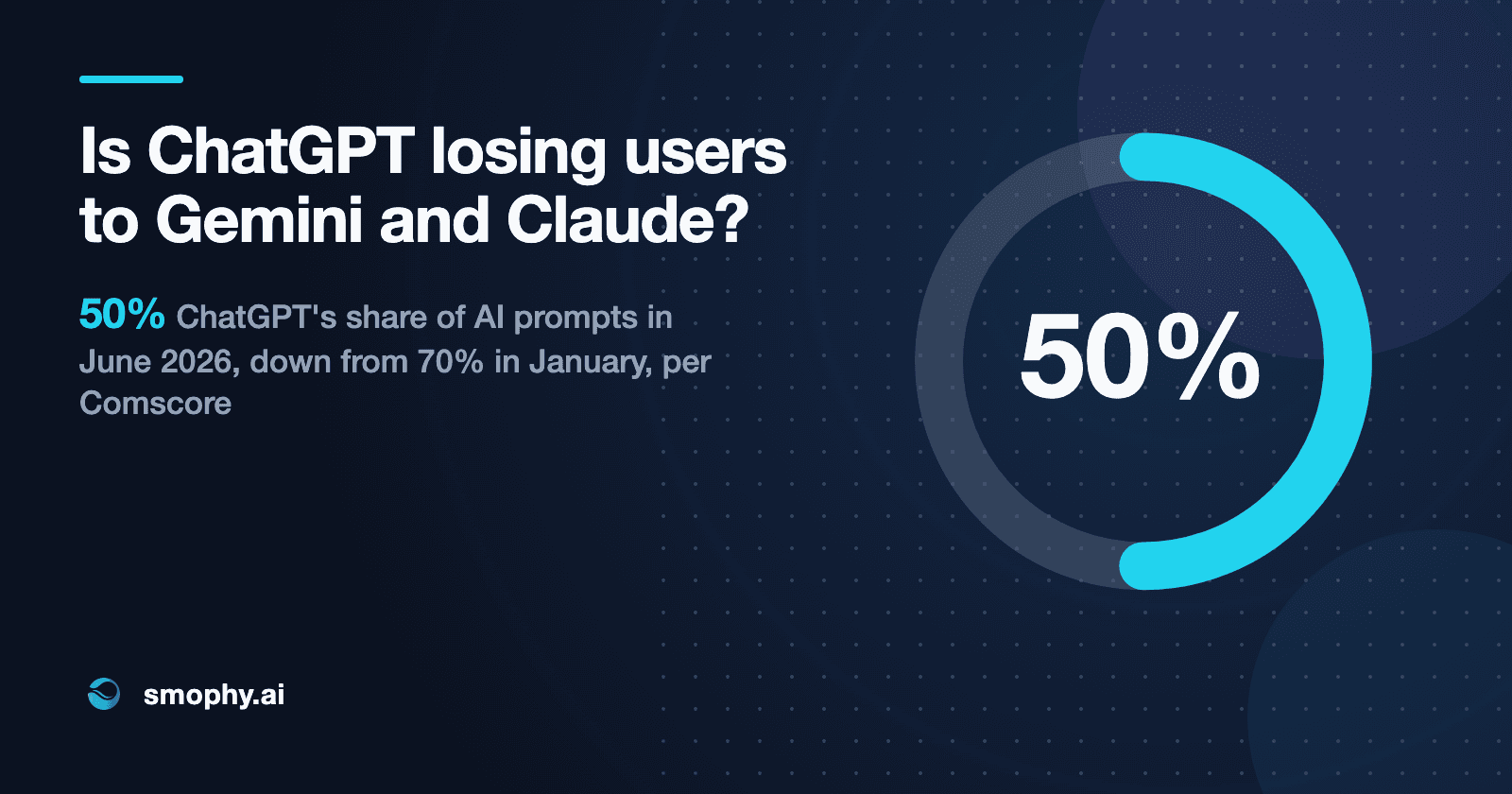
Its share is falling, but its use is not. Comscore found that ChatGPT's share of total AI prompt volume fell from 70% in January 2026 to 50% in June 2026, while Gemini rose from 17% to 30% and Claude from 2% to 11%. The Reuters Institute found that weekly use of ChatGPT rose from 22% to 34% over the previous year in the six countries it tracks. People are adding assistants more than they are dropping one.
What do the share numbers show?
They show how prompts are divided, which is not the same as how many people leave.
Comscore reports share of total AI prompt volume from its US panel data for January to June 2026. Comscore found that ChatGPT went from 70% to 50%, Gemini from 17% to 30% and Claude from 2% to 11%, and describes the change as consumers diversifying which assistants they use.
Share is a slice of a whole. When people send prompts to three assistants instead of one, the first assistant's slice shrinks even if its own number of prompts holds steady.
Are more people using ChatGPT, or fewer?
More, in the Reuters Institute's survey.
Reuters Institute research ran through a YouGov online survey in nine countries, with fieldwork from 14 August to 28 September 2026, and its trend figures average the six countries surveyed in earlier years. Its report is about news, but it measures how often people use each assistant. The Reuters Institute found that weekly use of standalone generative AI systems rose from 34% to 51% in a year and daily use from 16% to 28%. Looking at single assistants, the Reuters Institute found that ChatGPT weekly use rose from 22% to 34%, Gemini from 11% to 24% and Claude from 1% to 7%.
ChatGPT is still the largest in both sets of numbers. Its share fell because the others grew faster from a smaller base, and the pool of people using AI grew at the same time.
Do people who pay for AI stay with one provider?
Often they do not, according to a National Bureau of Economic Research working paper.
Researchers at the National Bureau of Economic Research used transaction level credit and debit card data covering 174 million US consumers and 114 billion transactions through April 2026. The National Bureau of Economic Research found that about 2.9% of US consumers pay for at least one major generative AI service. Across the major providers, the National Bureau of Economic Research also found that annual customer retention ranges from 20% to 45%, and that switching rises around major model releases. Working papers like this one have not been peer reviewed.
Those retention figures mean that a large share of each provider's paying customers is gone within a year.
What does this mean for you?
The assistant that suits you can change when a new model arrives.
Neither set of figures says that one assistant is better for everyone. They say that people spread their questions across several tools and that paying customers move around, often when a new model is released. Judging an assistant by its market share tells you little about how it handles your own work, and the only test that does is running your tasks on it.
How can you compare assistants on your own work?
Use the same prompt on each assistant and judge the answers yourself.
- Pick three tasks you do every week. Choose different kinds, such as writing a client email, summarizing a document and planning a project.
- Write each prompt once. Copy it exactly so that only the assistant changes.
- Send it to ChatGPT, Claude and Gemini in fresh chats. Give none of them extra hints.
- Mark what is better in each answer. Note accuracy, tone, structure and what is missing.
- Look for a pattern across the three tasks. One win on one task proves little.
- Repeat when a new model is released. The NBER finding that switching rises around releases is a reminder that last quarter's winner may not stay the winner.
What does the comparison cost with separate tabs?
Time, and it grows with every assistant you add.
Signing in to each service, pasting the same prompt and keeping the answers side by side takes effort for every assistant you want to include. One place that sends the prompt to all of them removes that effort.
How does SmophyAI help you compare?
SmophyAI is an AI workspace where ChatGPT, Claude, Gemini, Grok, Perplexity and DeepSeek answer the same prompt side by side in one subscription.
Multi-Chat sends one prompt to all six models at once, so the test above takes one prompt instead of six tabs. You read the answers next to each other, see where they agree and where one model offers something the others miss, and decide with your own task in front of you. You can start free and run your own question before you change anything.
Common questions
Is ChatGPT losing users to Gemini and Claude?
Its share of prompts is falling, but its weekly use is rising. Comscore found ChatGPT's share of AI prompt volume fell from 70% to 50% between January and June 2026, while the Reuters Institute found its weekly use rose from 22% to 34% in a year.
Is Gemini overtaking ChatGPT?
Not in these numbers. Comscore found Gemini's share of AI prompt volume rose from 17% to 30%, and the Reuters Institute found its weekly use rose from 11% to 24%, both still behind ChatGPT.
Is Claude growing?
Yes, from a small base. Comscore found Claude's share of prompt volume rose from 2% to 11%, and the Reuters Institute found its weekly use rose from 1% to 7%.
Do people switch AI providers a lot?
Many paying customers do. The National Bureau of Economic Research found annual customer retention of 20% to 45% across the major providers, with switching rising around model releases.
Can I try several assistants without paying for each one?
Yes. In SmophyAI, Multi-Chat sends one prompt to six models and shows the answers side by side.
Sources
About SmophyAI
SmophyAI is an AI workspace where ChatGPT, Claude, Gemini, Grok, Perplexity and DeepSeek answer the same prompt side by side in one subscription, with Best Answer, Smophy Mode routing and studios for images, video and writing. Try Multi-Chat
About the author.
Kamil Kępiński is the founder of Smophy Labs Inc. and builder of SmophyAI.