Are AI chatbots accurate on news and civic questions?
One study found 29% of chatbot answers on voting were incomplete, inaccurate or outdated, and accuracy varied by model. See how to check.

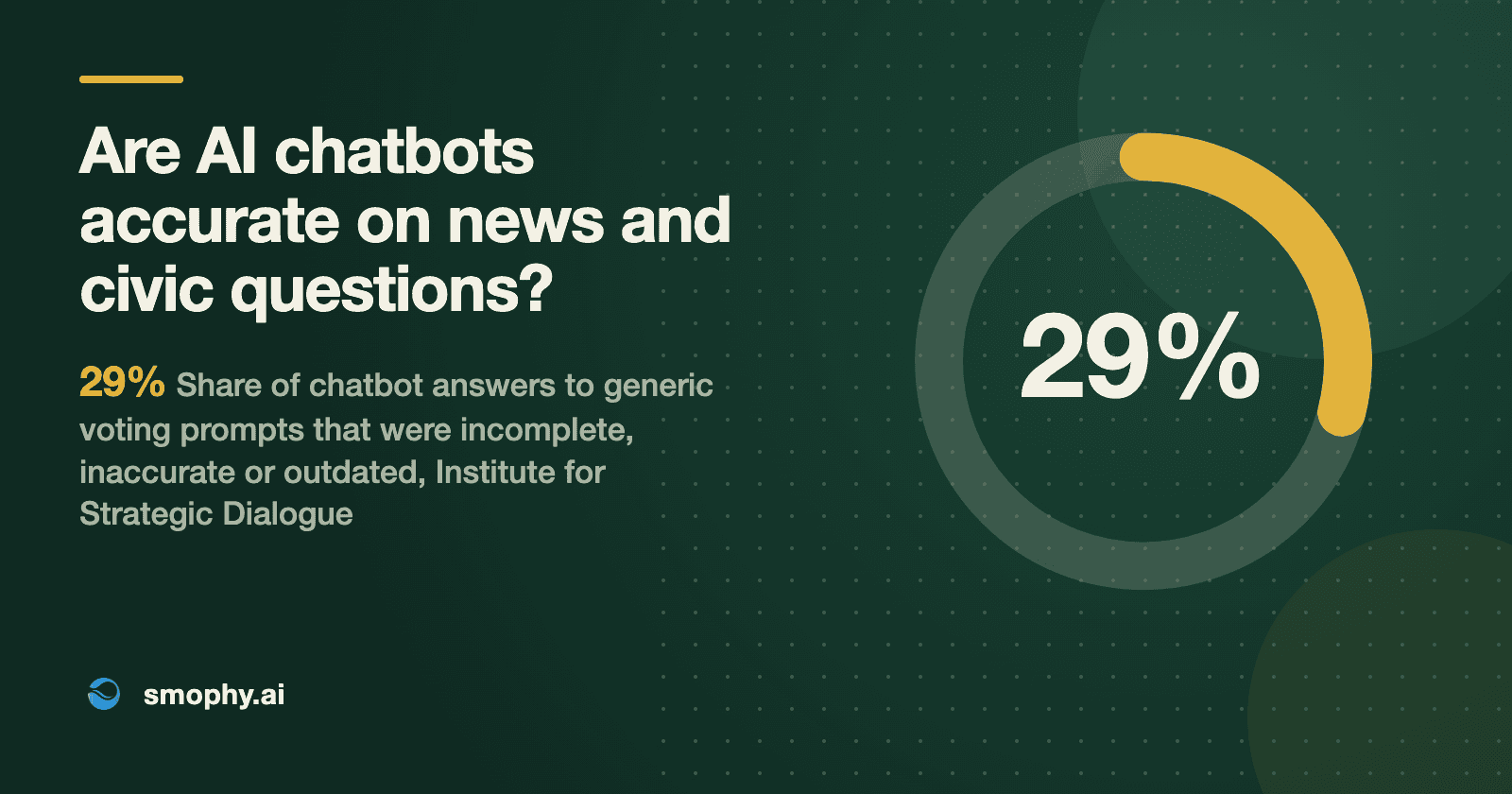
Not always, and the model you ask matters. The Institute for Strategic Dialogue put generic voting prompts to six chatbots and found that 29% of the responses were incomplete, inaccurate or outdated. Accuracy differed sharply by model, according to the Institute for Strategic Dialogue, from 89% for GPT-5.5 and 84% for Gemini 3.5 Flash down to 61% for Muse Spark. One chatbot's answer is a starting point, so check the facts that matter against the official source and compare more than one model.
What did the voting study find?
Accuracy depended on which chatbot answered, according to the Institute for Strategic Dialogue.
Its report is titled "Chatbots and the Ballot Box: US elections". In mid-June 2026 the researchers put 15 generic voter prompts in English and Spanish, plus adversarial prompts, to six chatbots, and the responses were checked against the facts and coded, according to the Institute for Strategic Dialogue. Of the chatbot responses to the English generic voting prompts, 29% were incomplete, inaccurate or outdated, the Institute for Strategic Dialogue found.
What stands out is the spread between models: accuracy was 89% for GPT-5.5, 84% for Gemini 3.5 Flash and 61% for Muse Spark, according to the Institute for Strategic Dialogue.
Do people really ask chatbots about the news?
Yes, a growing share do, according to Pew Research Center.
Pew Research Center found that as of summer 2026, 15% of US adults say they get news from AI chatbots at least sometimes, up from 9% in 2025. Only 1% name AI chatbots as their preferred platform for news, according to Pew Research Center. People use chatbots for news as one source among others, and the share is rising.
Do people ask about elections too?
Some do, according to Pew Research Center.
Pew Research Center surveyed 5,273 US adults from 12 to 18 October 2026 and found that 8% say they are using AI chatbots to find election-related information this year. Most people did not, and the share that did was still large enough that the quality of those answers matters.
How common is chatbot use in general?
In the six countries with data from previous years, weekly use rose from 34% to 51%, according to the Reuters Institute.
The Reuters Institute for the Study of Journalism ran a YouGov online survey in nine countries from 14 August to 28 September 2026. In the six countries with data from previous years, the Reuters Institute found that weekly use of standalone generative AI systems and chatbots rose from 34% last year to 51% in 2026. The Reuters Institute also found that daily use rose from 16% to 28%.
The more people ask chatbots, the more it matters whether the answer is right.
Why does the model you pick matter?
Because chatbots are not interchangeable, and a single answer hides the differences.
In the Institute for Strategic Dialogue's test, the most and the least accurate chatbots were far apart on the same prompts. If you only ever ask one chatbot, you cannot see whether your answer came from the strong end or the weak end of that range. Asking several shows you where they agree, where one differs and which claim needs a source.
How do you check an AI answer about the news or a civic question?
Ask more than one model, then check the facts that carry the decision against the official source.
- Write the question with the details that matter. Include the place and the topic, such as your state, your county or the rule you are asking about.
- Send the same text to at least three models in fresh chats. Use identical wording so the only difference is the model.
- Mark what all of them say. Shared answers are the best candidates to confirm first.
- Mark where one model differs. Each difference is a claim to check, not a result to pick.
- Ask each model for its source. Open the source yourself and see whether it says what the model says.
- Look for outdated details. Deadlines, locations and rules change, so confirm the current version on the official site.
- Use the official source for the final answer. Treat the chatbots as a way to find the right question and the right page.
What does the comparison cost with separate tabs?
Time, and it grows with every model you add.
Three models and one question mean three sign-ins, three pasted prompts and three windows to line up by hand. One place that sends the prompt to all of them removes that work, and the comparison becomes a habit instead of a chore.
How does SmophyAI help you compare?
SmophyAI is an AI workspace where ChatGPT, Claude, Gemini, Grok, Perplexity and DeepSeek answer the same prompt side by side in one subscription.
Multi-Chat sends one prompt to all six models at once. You read the answers next to each other, see where they agree and where one pushes back, and take the claims that differ to the official source. You can start free and run your own question before you rely on any answer.
Common questions
Are AI chatbots accurate?
Not always, and it depends on the model. The Institute for Strategic Dialogue found that 29% of chatbot responses to generic voting prompts were incomplete, inaccurate or outdated, with accuracy from 89% to 61% across models.
Can I trust AI chatbots for news?
Use them as one source and check the facts that matter. Pew Research Center found that 15% of US adults get news from AI chatbots at least sometimes, but only 1% name chatbots as their preferred news platform.
Do AI chatbots give accurate answers about elections?
Sometimes, and not equally. The Institute for Strategic Dialogue measured accuracy of 89% for GPT-5.5 and 61% for Muse Spark on generic voting prompts, so confirm voting details on the official election site.
How many people use AI chatbots every week?
The Reuters Institute for the Study of Journalism found that weekly use of standalone AI systems and chatbots rose from 34% to 51% in six countries between last year and 2026.
How can I check an AI answer without trusting one model?
Send the same question to several models, mark where they agree and differ, and verify the differences against the official source. In SmophyAI, Multi-Chat shows six models side by side.
Sources
About SmophyAI
SmophyAI is an AI workspace where ChatGPT, Claude, Gemini, Grok, Perplexity and DeepSeek answer the same prompt side by side in one subscription, with Best Answer, Smophy Mode routing and studios for images, video and writing. Try Multi-Chat
About the author.
Kamil Kępiński is the founder of Smophy Labs Inc. and builder of SmophyAI.