Which AI model makes up answers least often?
Full Fact tracked 7,625 chatbot answers over 70 days and found answers changed day to day. See what the data says and how to check one model against five.

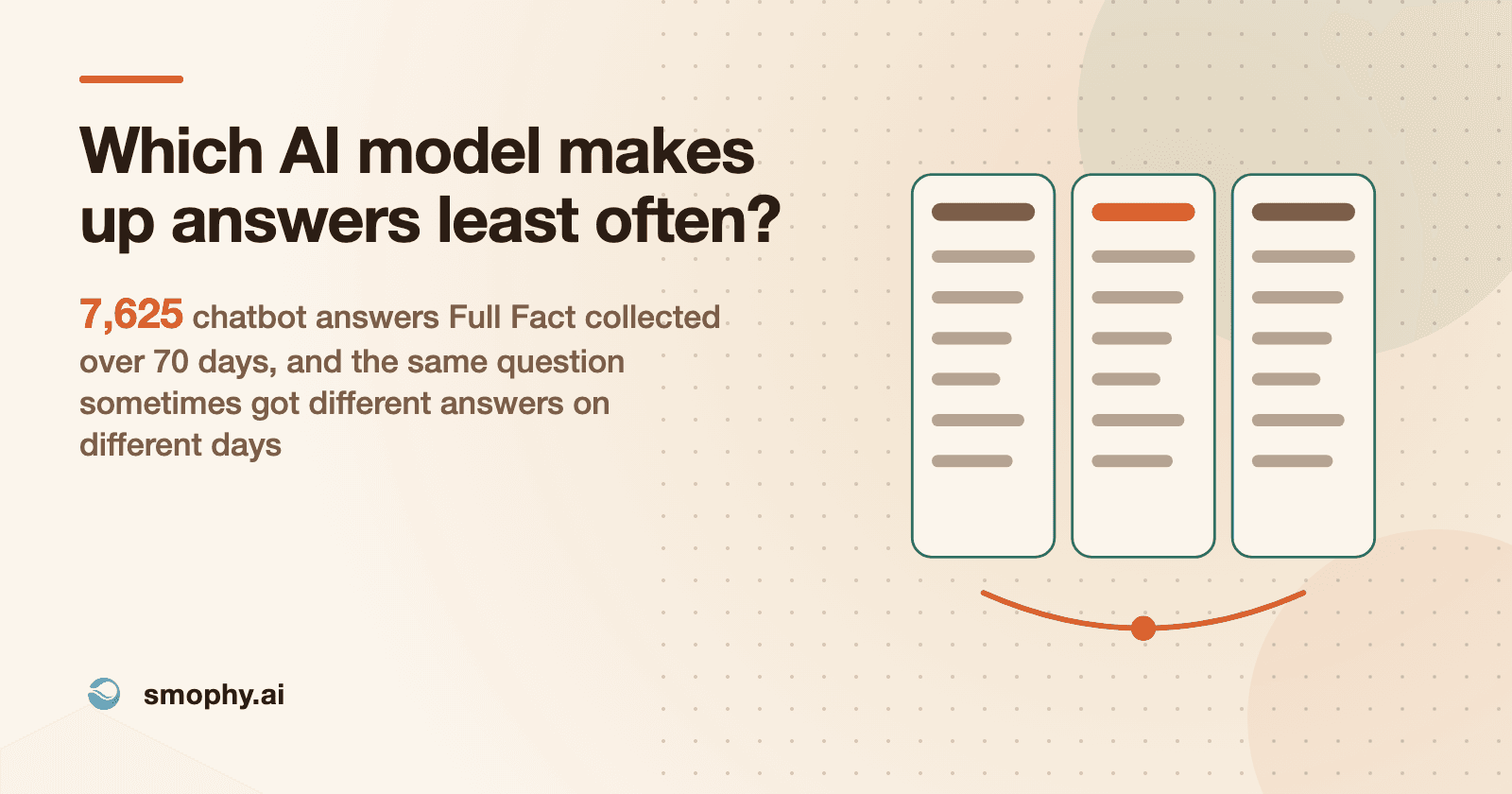
No single model wins every test, so check an important answer on more than one model. Full Fact collected 7,625 chatbot responses to the same 22 questions over 70 days and found that models sometimes gave different answers to the same question on different days. The Vectara Hallucination Leaderboard shows rates from 1.8% to 5.6% when models summarize a document they were given. One practical way to catch a made up answer is to compare several models side by side.
What did Full Fact find when it asked the same questions every day?
It found that the same chatbot can be right on one day and wrong on another.
Full Fact collected 7,625 responses from five chatbots (Gemini, ChatGPT, Grok, DeepSeek and Claude) to the same 22 questions asked daily from 15 July to 22 September 2026. Fact checkers annotated the answers against benchmark answers. Full Fact reported that models sometimes gave different answers to the same question on different days.
That is the part to remember. Yesterday's correct answer does not promise today's correct answer, so one good result from one model is a weak reason to trust it.
How often do models make things up on a plain task?
When the answer sits in a document the model was given, the rates are low but not zero.
The Vectara Hallucination Leaderboard asked models to summarize more than 7,700 documents and scored how often a summary contained something the document did not say. The Vectara Hallucination Leaderboard reported rates from 1.8% for the best model to 5.6% for the lowest scoring model it listed.
Even the low numbers mean that some summaries contain statements the source does not support. When the task is harder than summarizing a document, the risk grows. Picture a founder who asks a model for a market size or a deadline and pastes the answer into a plan. If that number is wrong, the plan carries the error, which is why a second opinion on an important answer is worth asking for.
Does the most accurate model make up the fewest answers?
Not always, because a model can be accurate and still guess when it does not know.
Artificial Analysis built AA-Omniscience from 6,000 hard knowledge questions across 42 topics. In its results, Claude 4.5 Haiku had the lowest hallucination rate at 28%, and Anthropic took the top three places for that measure. Artificial Analysis also reported that models with the highest accuracy, such as Grok 4, GPT-5 and Gemini 2.5 Pro, did not lead its Omniscience Index because they guess more often than they decline to answer.
So two models can both look strong on accuracy while behaving differently on the moment that matters most: what they do when they are unsure.
How do you catch a made up answer in practice?
Send the same question to several models and read where they disagree.
- Write the question once. Include the facts you already know so every model starts from the same ground.
- Send it to several models at the same time. Use identical wording so only the model changes.
- Mark the points all answers share. Shared points are the safer baseline.
- Mark the points only one model stated. Those are the ones to verify before you use them.
- Check the flagged points against a source. Open the page, the document or the data the claim comes from.
- Repeat before you rely on an important answer again. Answers can change from one day to the next.
This turns one confident reply into a short list of claims with a reason to check each one.
How does SmophyAI help with that check?
SmophyAI is an AI workspace where ChatGPT, Claude, Gemini, Grok, Perplexity and DeepSeek answer the same prompt side by side in one subscription.
Multi-Chat sends one prompt to all six chat models at once, so the comparison in the middle of the checklist takes one prompt instead of six tabs. Live web search is on by default across the six models, which helps because answers that name a source are easier to check. Best Answer combines the strongest information from the six responses into one answer, and the six originals stay side by side so you can see where each point came from. You can start free with a one time trial of 10 chat messages and 3 images.
Common questions
Which AI model hallucinates least?
It depends on the task. The Vectara Hallucination Leaderboard found rates from 1.8% to 5.6% when models summarize a document they were given, and Artificial Analysis found that the model with the lowest hallucination rate on hard knowledge questions was Claude 4.5 Haiku at 28%.
Do AI chatbots give the same answer every day?
Not always. Full Fact found that models sometimes gave different answers to the same question on different days.
Is a more accurate model also more reliable?
Not necessarily. Artificial Analysis found that some of the most accurate models guess more often than they abstain, which affects how often they make up an answer.
How can I check whether an AI answer is wrong?
Ask several models the same question and read where they disagree, then check the points only one model stated against a source.
Can I compare several AI models without paying for each one?
Yes. In SmophyAI, Multi-Chat sends one prompt to six chat models side by side, and you can start free before you pay.
Sources
About SmophyAI
SmophyAI is an AI workspace where ChatGPT, Claude, Gemini, Grok, Perplexity and DeepSeek answer the same prompt side by side in one subscription, with Best Answer, Smophy Mode routing and studios for images, video and writing. Try Multi-Chat
About the author.
Kamil Kępiński is the founder of Smophy Labs Inc. and builder of SmophyAI.