Do different AI chatbots give different answers to the same question?
Institute for Strategic Dialogue found chatbot accuracy ranged from 89% to 61% on the same voting questions. How to check an answer that matters.

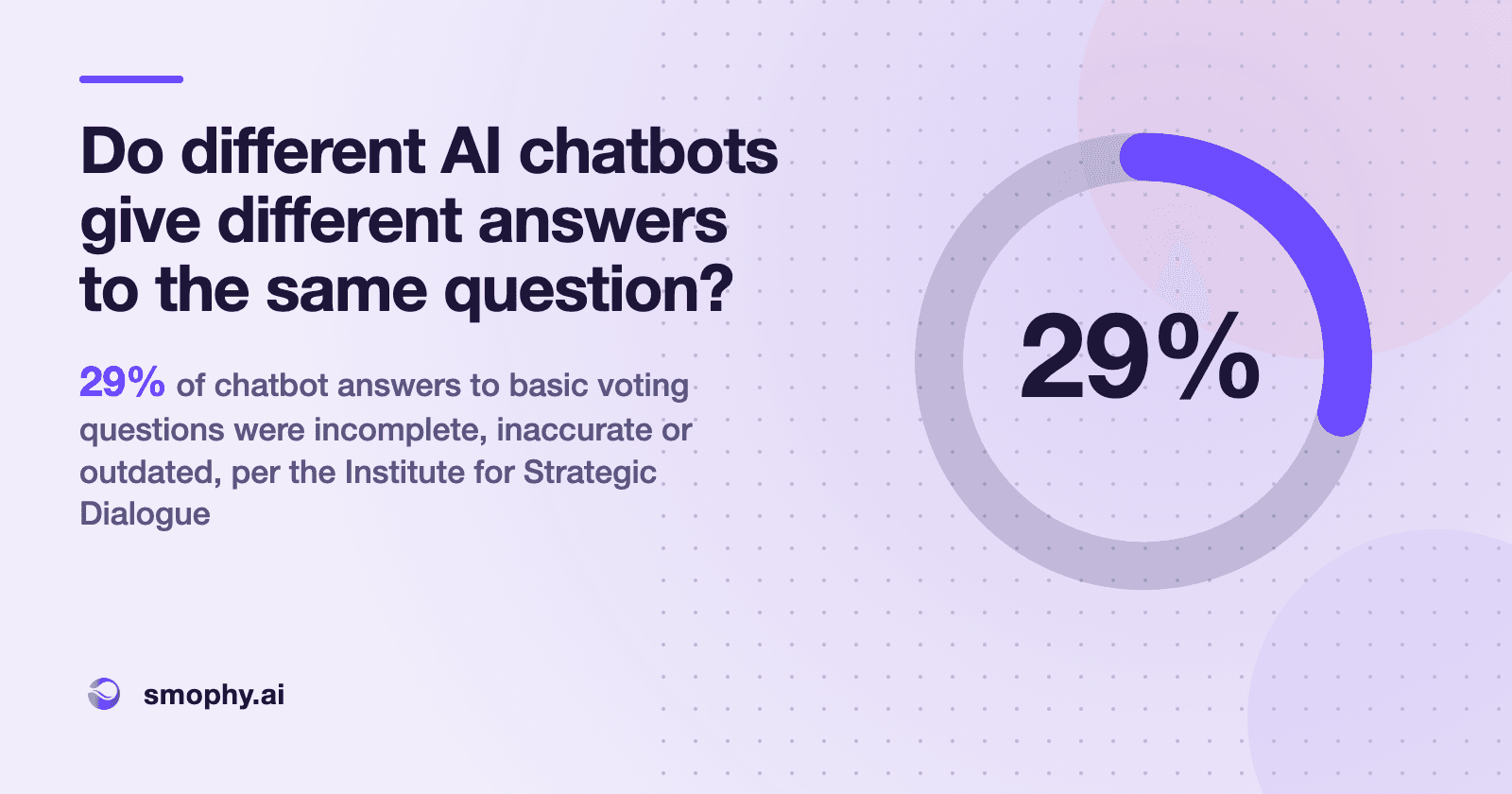
Yes, and sometimes the same chatbot does too. When the Institute for Strategic Dialogue put the same voting questions to six chatbots, the share of fully accurate responses ranged from 89% for the top model to 61% for the lowest, and 29% of English responses were incomplete, inaccurate or outdated. Full Fact asked five chatbots the same 22 questions every day and found that models sometimes gave different answers on different days. One answer is a draft to check, not a verdict.
How different are chatbot answers to the same question?
Enough that the choice of model changes the result.
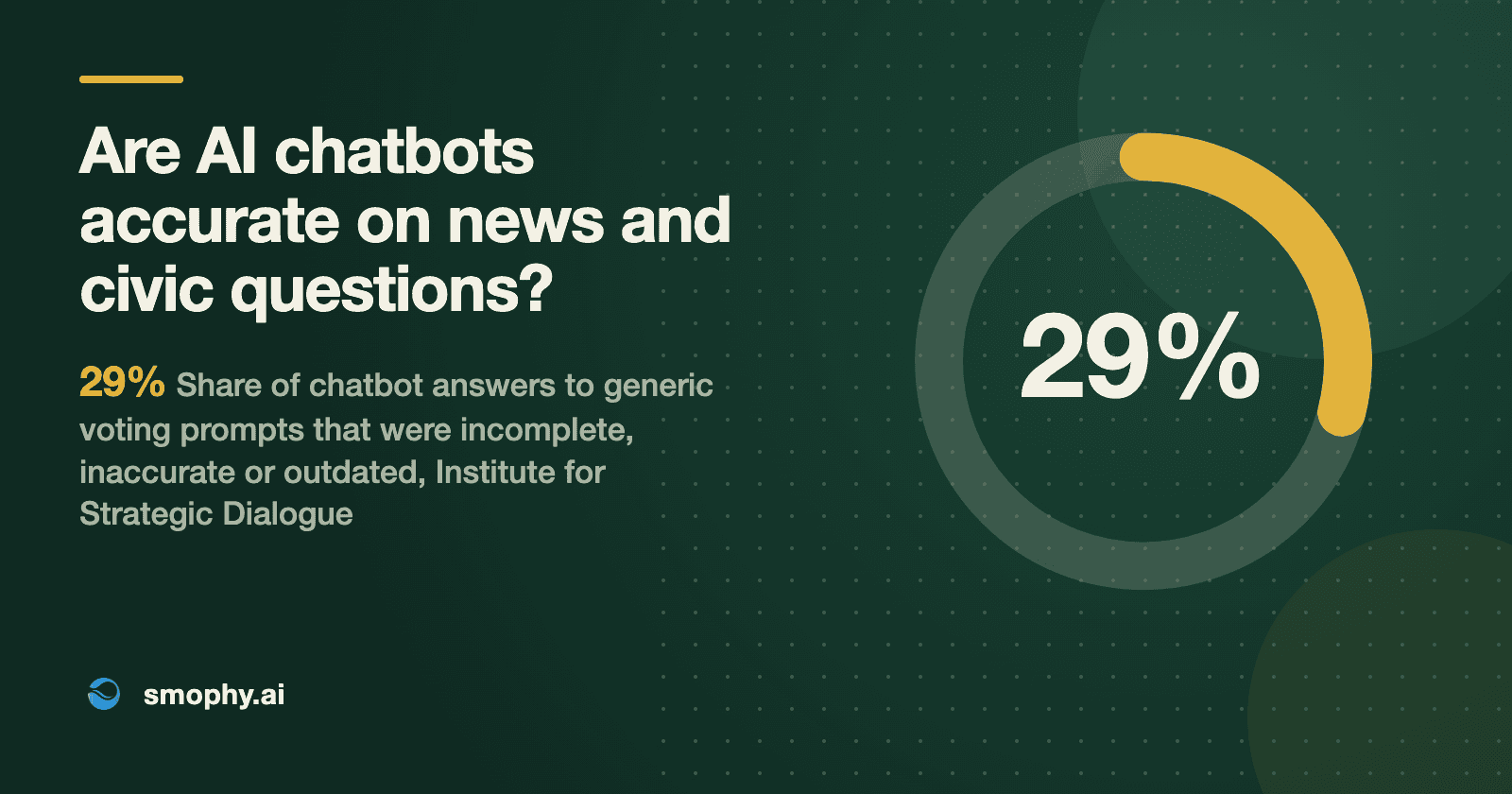
The Institute for Strategic Dialogue tested six chatbots with 15 generic voter questions in English and Spanish, collected in June 2026, and compared every response with verified election information. The Institute for Strategic Dialogue reports that 29% of responses to English generic prompts were incomplete, inaccurate or outdated.
Between models, the spread was wide. According to the Institute for Strategic Dialogue, GPT-5.5 gave accurate, specific and complete information in 89% of responses and Gemini 3.5 Flash in 84%, while Muse Spark scored 61%. This test covered one topic at one moment, so it does not rank the models for every job. It does show that two chatbots can read the same question and hand you answers of very different quality.
Does the same chatbot answer the same way every day?
Not always.
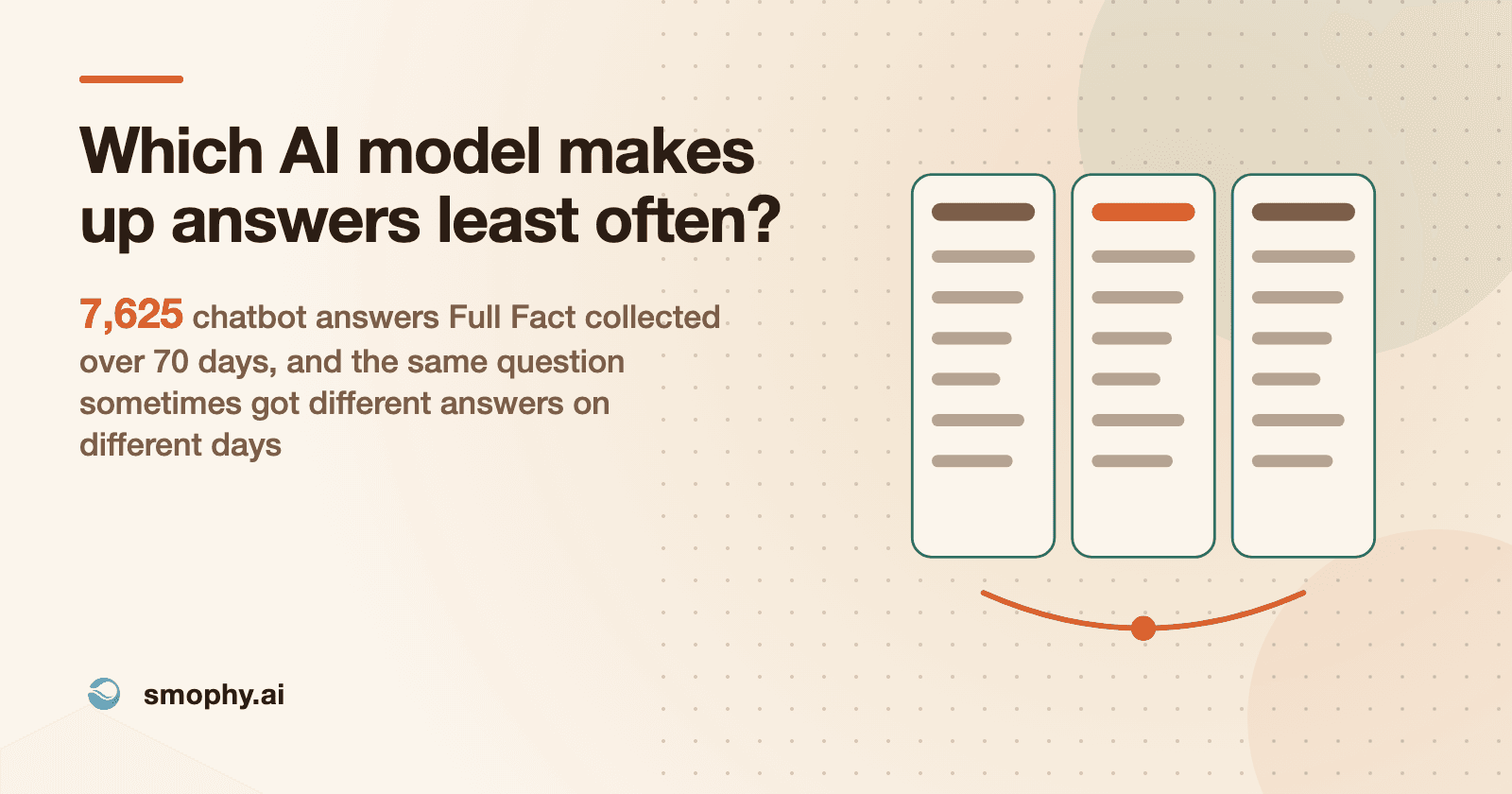
Full Fact collected 7,625 responses from five widely used chatbots (Gemini 3.1, ChatGPT, Grok, DeepSeek and Claude) to the same 22 questions, asked daily from 15 July to 22 September 2026, with web search allowed. Fact checkers annotated the answers against benchmark answers. Full Fact found that models sometimes gave different answers to the same question on different days.
For a daily user, that means a chat that was right on Monday can be wrong on Sunday for the same prompt. Asking again, or asking a second model, is a cheap way to see whether an answer is stable.
Can an AI stand in for what real people say?
Only partly, and the gaps can be large.
Pew Research Center tested an AI model that answered survey questions as digital twins of real panelists, using their demographics and political typology answers. Pew Research Center found that the average difference from the humans' answers exceeded 15 points on around 28% of the questions asked. The model sounded plausible on every question, yet on more than one in four it landed far from what the real person said.
Confident wording is not a sign of accuracy. The way to find the weak spots is to compare against something outside the model.
Do people check what chatbots tell them?
Many do, when the answer matters.
Pew Research Center found that 8% of US adults use AI chatbots to find election-related information, in a survey of 5,273 adults conducted from October 12 to 18, 2026. Pew Research Center also found that among those who do, 71% used them to check the accuracy of things they had heard or read elsewhere about the candidates or issues. People are already using chatbots as a second opinion, which makes it more important that the second opinion is itself checked.
Do heavy AI users compare models?
Many professionals do, and the habit is common among people who build with AI.
The Amplify Partners 2026 AI Engineering Report, a survey of more than 1,000 engineers building in AI, found that 87% of respondents actively use multiple models together, and that 26% run multiple models and compare outputs. These are builders, not everyday users, but the method carries over: different models for different jobs, and a comparison when the result matters.
How can you check an answer that matters?
Treat the first answer as a draft and test it before you act on it.
- Mark the claims you will act on. Pick the numbers, dates, names and recommendations that would cost you something if they were wrong.
- Ask a second model the same question. Use the same wording in a fresh chat and read where the two answers differ.
- Ask again later. Repeat the question on another day, because the same chatbot can answer differently over time.
- Ask for the source. Request the page or document behind each figure, then open it yourself.
- Keep the wording of the question stable. Save the prompts that gave you useful answers so you can compare like with like.
- Note which model handles which job. After a few checks you will see where each model is strong and where it needs a second look.
How does SmophyAI help you compare chatbot answers?
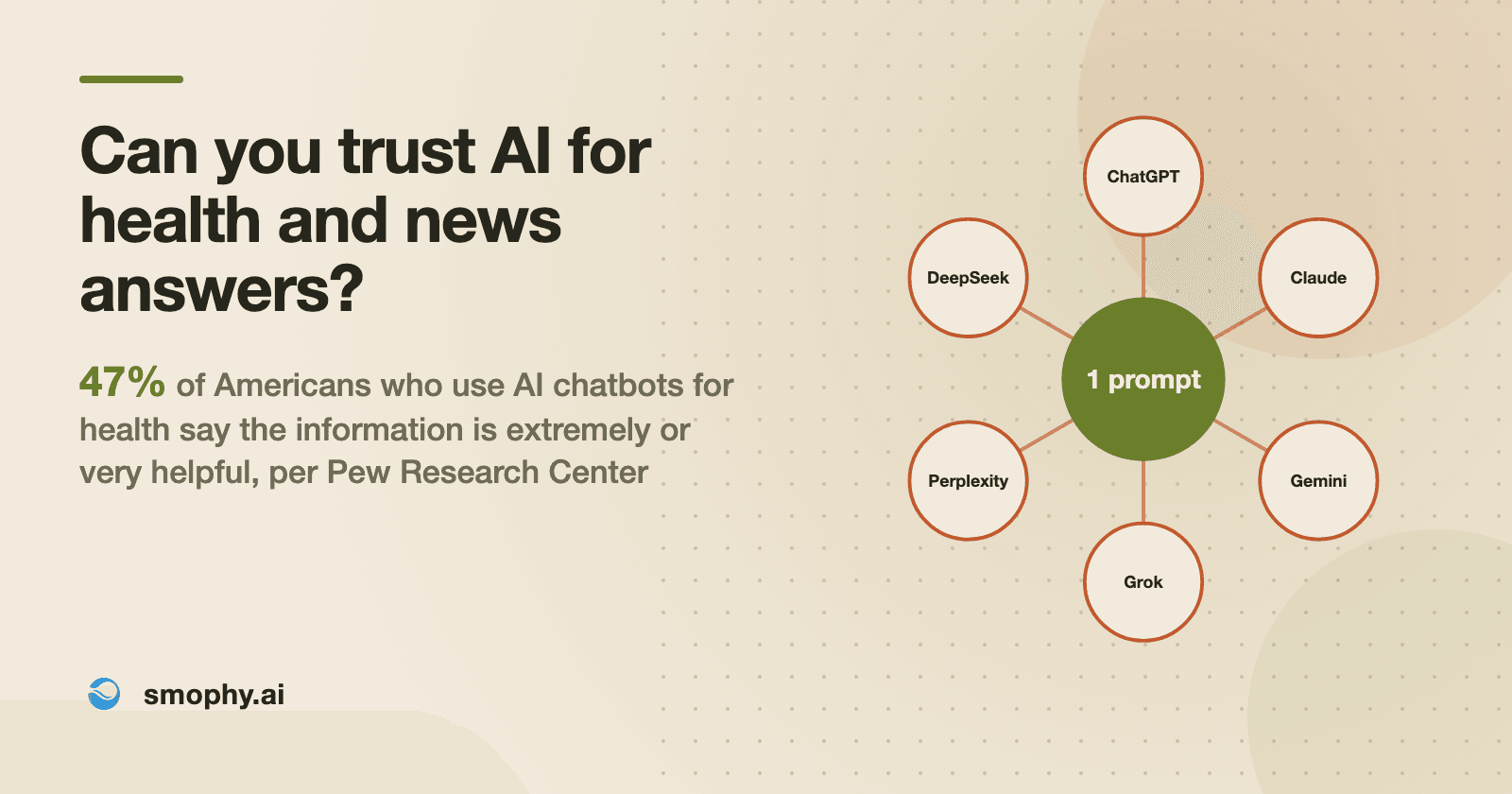
SmophyAI is an AI workspace where ChatGPT, Claude, Gemini, Grok, Perplexity and DeepSeek answer the same prompt side by side in one subscription.
Multi-Chat sends one prompt to all six models at once, so step two above takes one prompt instead of six tabs and logins. You read the answers next to each other and see at once where they agree and where they differ. Best Answer then combines the strongest information from the six responses into one reply. For a question where a wrong detail would cost you, the differences between models point you to the lines worth opening a source for. You can start free with your own question.
Common questions
Do different AI chatbots give different answers to the same question?
Yes. The Institute for Strategic Dialogue found that chatbot responses to the same voting questions were fully accurate between 89% and 61% of the time, depending on the model.
Does ChatGPT give the same answer every time?
Not always. Full Fact asked five chatbots the same 22 questions every day for 70 days and found that models sometimes gave different answers on different days.
How accurate are AI chatbots?
It depends on the question and the model. The Institute for Strategic Dialogue found that 29% of English responses to basic voting questions were incomplete, inaccurate or outdated.
Is a confident AI answer a correct one?
Not by itself. Pew Research Center found that an AI model answering as digital twins of real panelists differed from the humans' answers by more than 15 points on average on around 28% of the questions.
How do I check an AI answer that matters?
Ask a second model the same question, repeat it on another day, ask for the source behind each figure and open it yourself.
Sources
- Institute for Strategic Dialogue, Chatbots and the Ballot Box
- Full Fact, Wrong on Sunday, right on Monday. Why AI chatbots have a confidence problem
- Pew Research Center, Can AI stand in for human survey takers? Not really
- Pew Research Center, Few Americans Say They Are Asking AI Chatbots for 2026 Election Information
- Amplify Partners, The 2026 AI Engineering Report
About SmophyAI
SmophyAI is an AI workspace where ChatGPT, Claude, Gemini, Grok, Perplexity and DeepSeek answer the same prompt side by side in one subscription, with Best Answer, Smophy Mode routing and studios for images, video and writing. Try Multi-Chat
About the author.
Kamil Kępiński is the founder of Smophy Labs Inc. and builder of SmophyAI.