Is there one AI model that is best at everything?
Epoch AI's index ranks GPT-6 Astra first overall, yet Claude Fable 5.1 scores higher on software engineering. See what that means for choosing a model.

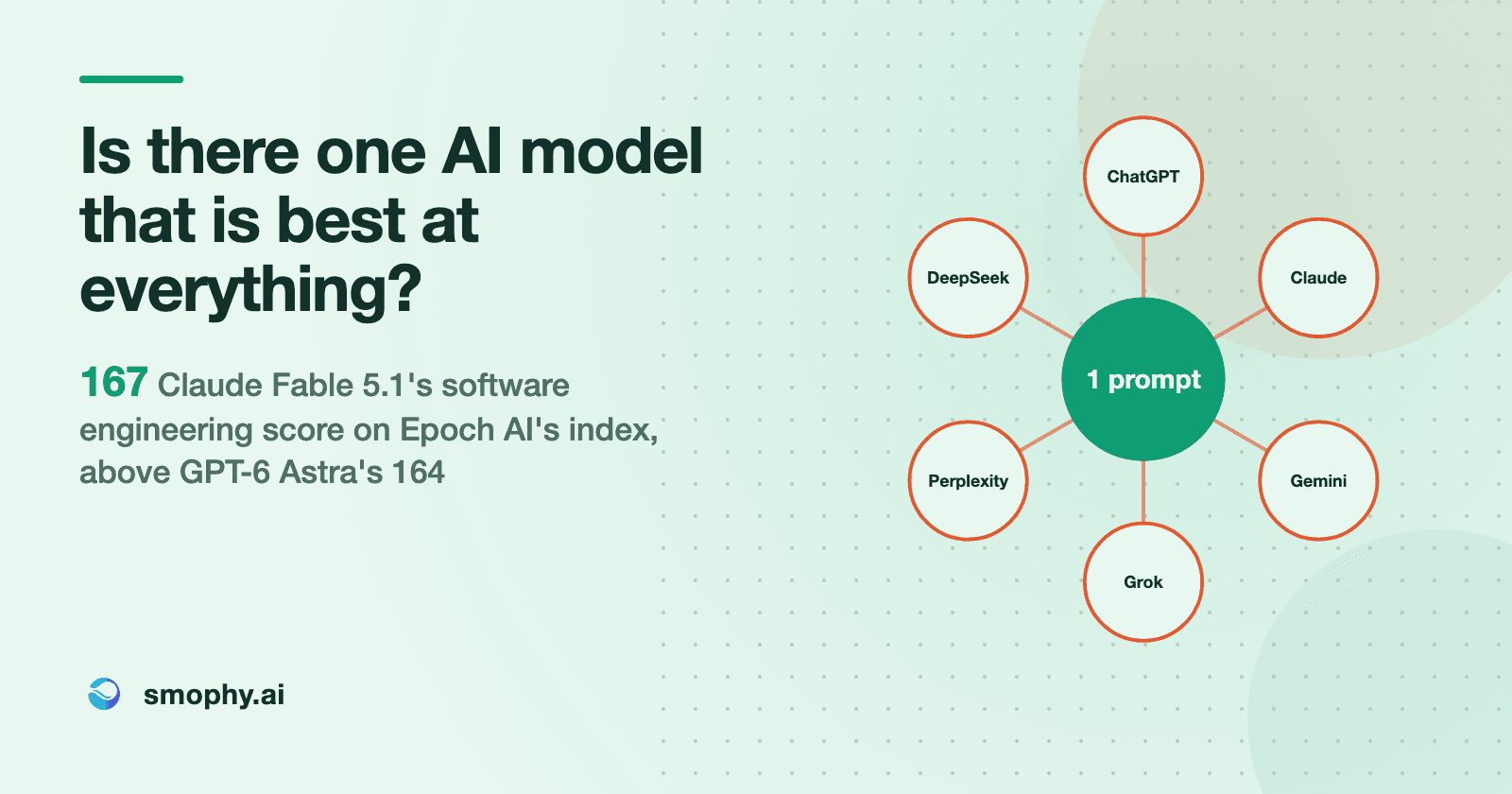
No. Epoch AI's composite index ranks OpenAI's GPT-6 Astra first overall with a score of 166, ahead of Anthropic's Claude Fable 5.1 at 164, but on software engineering benchmarks Claude Fable 5.1 scores 167 against Astra's 164. The model that leads on average can still lose on the task you care about. Comparing models on your own work is the dependable way to choose.
Which AI model is best overall?
GPT-6 Astra comes first in Epoch AI's index, by a small margin.
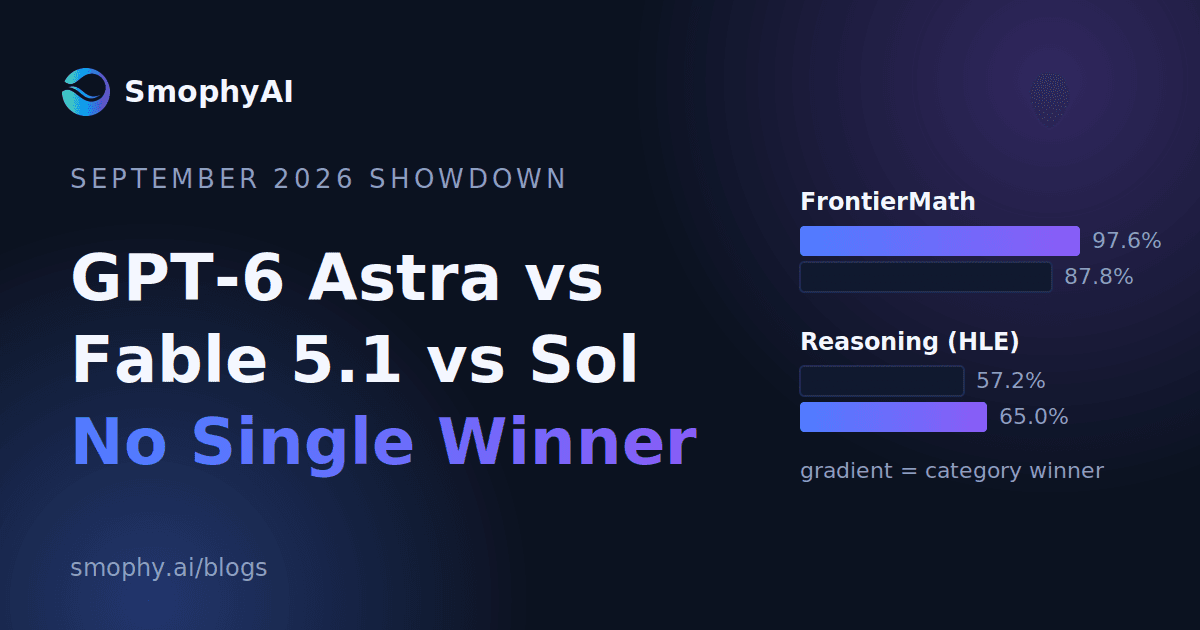
The Epoch Capabilities Index (ECI) is a composite measure of model capabilities built from many benchmarks. Epoch AI reports that GPT-6 Astra tops it with a score of 166, ahead of Claude Fable 5.1 at 164 and GPT-5.6 Sol at 162.
Does the top model win on every task?
It does not, even in the index that ranks it first.
Epoch AI split the score by kind of work. On math, Astra's math score of 170 sets a new record, Epoch AI reports. Epoch AI also reports that on software engineering benchmarks Astra's software engineering score of 164 still lags behind Claude Fable 5.1's 167.
The overall leader and the coding leader are different models. If most of your work is code, the score that matters to you is the software engineering score, not the overall score.
Why does one model not win everything?
Models are strong in different places, and a single average hides that.
The index adds many benchmarks into one number, and the split by kind of work shows what the sum hides. Strong math can lift a model to first place overall while it trails on software engineering. Your own tasks may sit in one corner of the benchmark mix, so the overall rank tells you little about them.
Do people who build with AI use one model or several?
Several, according to a survey of AI engineers.
Amplify Partners surveyed more than 1,000 engineers building in AI for its 2026 AI Engineering Report. Amplify Partners found that 87% of respondents actively use multiple models together, and that the top routing method is by task type at 44%. Another 26% run multiple models and compare their outputs.
People closest to the technology treat models as tools for different jobs and not as rivals for one title.
Do people stay with the model they started with?
Many do not.
Recon Analytics tracked US adults in 13 weekly waves from June 26 to September 18, 2026, and asked 31,569 of them about switching. Recon Analytics found that 18% of AI users changed their primary AI tool in the previous three months, roughly 6% a month. Among 5,751 respondents who named both tools, Recon Analytics reports that ChatGPT gained a net 8%, Claude 4% and Gemini 3%.
Switching goes in several directions at once, which fits the picture that no single model fits everyone. Each person has a different mix of tasks, budgets and habits, so the model that suits a colleague may not suit you, and the only way to know is to try your own work on more than one.
How do you pick a model for your own work?
Test your own tasks on several models and compare the answers.
- Pick three tasks you do every week. Choose different kinds, such as writing, analysis and code.
- Write each prompt once. Copy it exactly so that only the model changes.
- Send it to at least three models in fresh chats. Give none of them extra hints.
- Judge the answers on what you need. Note accuracy, tone, structure and what is missing.
- Note which model wins which task. Expect the winner to change from task to task.
- Repeat when a new model appears. Leaderboards shift, and last month's winner may not stay on top.
What does the comparison cost with separate tabs?
Time, and it grows with every model you add.
Signing in to each service, pasting the same prompt and keeping the answers side by side takes effort for each model. With six models, that means six logins, six pasted prompts and six windows to line up by hand before you can read a single comparison. One place that sends the prompt to all of them removes that effort.
How does SmophyAI help you compare?
SmophyAI is an AI workspace where ChatGPT, Claude, Gemini, Grok, Perplexity and DeepSeek answer the same prompt side by side in one subscription.
Multi-Chat sends one prompt to all six models at once, so the test above takes one prompt instead of six tabs. You read the answers next to each other, see where they agree and where one model offers something the others miss, and decide with your own task in front of you. You can start free and run your own question before you change anything.
Common questions
Is there one AI model that is best at everything?
No. Epoch AI ranks GPT-6 Astra first overall with 166, yet Claude Fable 5.1 scores 167 on software engineering against Astra's 164.
Which AI model is best overall?
In Epoch AI's index it is GPT-6 Astra at 166, ahead of Claude Fable 5.1 at 164 and GPT-5.6 Sol at 162, with a small margin.
Which AI model is best for coding?
On software engineering benchmarks in Epoch AI's index, Claude Fable 5.1 scores 167, ahead of GPT-6 Astra at 164.
Do professionals use more than one AI model?
Many do. Amplify Partners found that 87% of surveyed AI engineers actively use multiple models together.
Can I compare several models without paying for each one?
Yes. In SmophyAI, Multi-Chat sends one prompt to six models and shows the answers side by side.
Sources
About SmophyAI
SmophyAI is an AI workspace where ChatGPT, Claude, Gemini, Grok, Perplexity and DeepSeek answer the same prompt side by side in one subscription, with Best Answer, Smophy Mode routing and studios for images, video and writing. Try Multi-Chat
About the author.
Kamil Kępiński is the founder of Smophy Labs Inc. and builder of SmophyAI.